
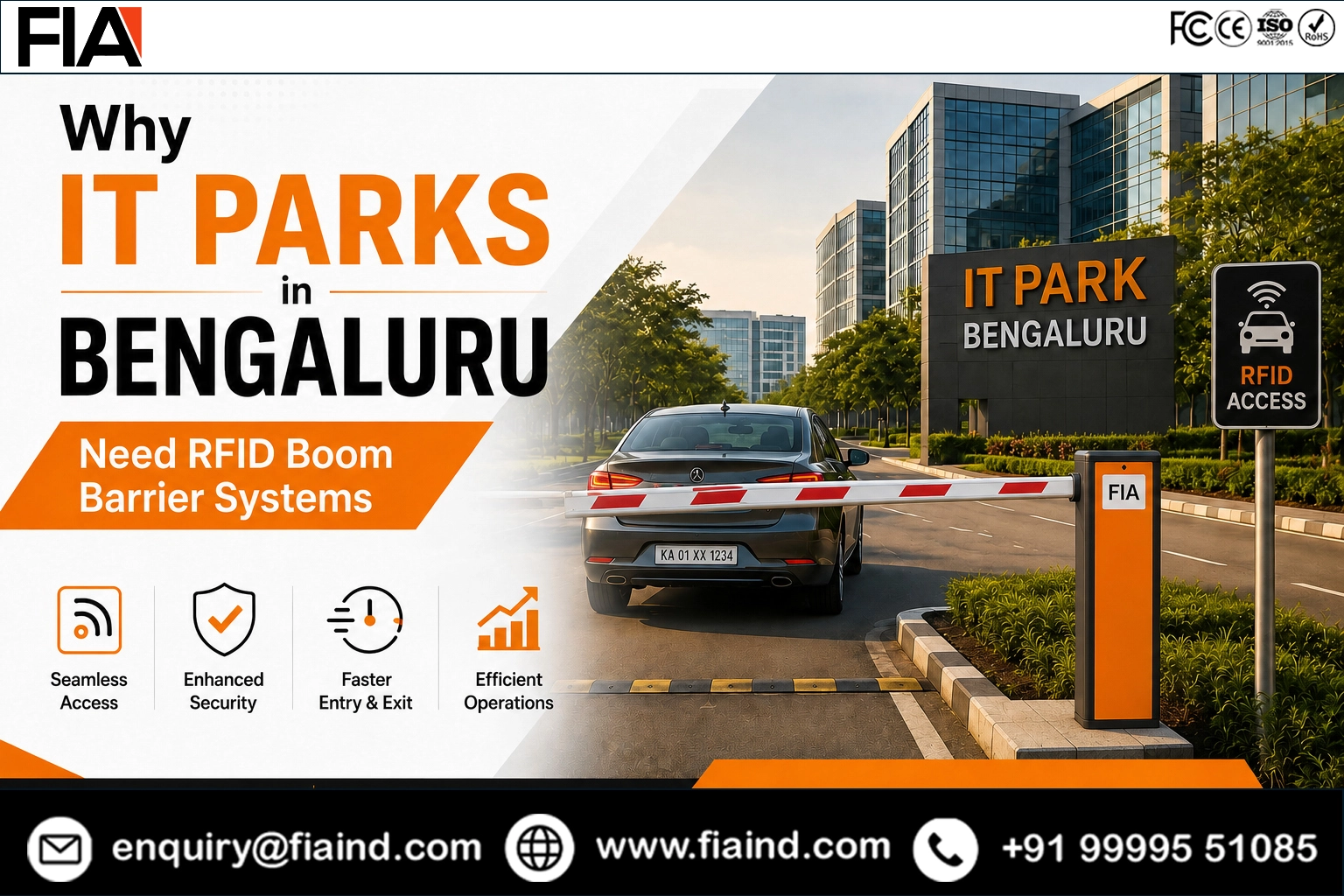
Bengaluru is home to India’s largest concentration of IT parks, technology campuses, and global innovation centres. From Electronic City and Whitefield to Outer Ring Road and Manyata Tech Park, these sprawling campuses host thousands of employees, vendors, delivery partners, and visitors every single day. With this scale comes a problem that facility managers and security heads know all too well: how do you let the right vehicles in quickly, keep unauthorised ones out, and still maintain a record of everything that happens at the gate?
The answer that a growing number of Bengaluru’s IT parks are turning to is the RFID boom barrier system — a smart, automated, and contactless vehicle access control solution. In this article, we take a detailed look at why this technology has become almost essential for modern tech campuses, how it actually works, and what facility teams should look for before adopting one.
The Access Control Challenge Inside Bengaluru’s Tech Corridors
Most IT parks in Bengaluru were designed for a fraction of the traffic they handle today. A single campus may have multiple towers, several thousand employees working in shifts, hundreds of cabs and two-wheelers entering during peak hours, and a constant stream of vendor trucks, courier vehicles, and visitor cars. Add to this the security expectations of multinational tenants who require strict access logs, and the picture becomes clear: manual boom barriers operated by a guard checking ID cards or sticker passes simply cannot keep up.
The result is familiar to anyone who has driven into a tech park at 9:30 am — long queues at the gate, frustrated employees stuck in traffic inside the campus itself, and security guards under pressure to verify vehicles quickly while also maintaining accuracy. Beyond the inconvenience, there is a real security gap. Manual checks are inconsistent, paper or sticker-based passes can be duplicated, and there is often no reliable digital trail of which vehicle entered or exited at what time.
This is precisely the gap that RFID-based automation closes.
What Is an RFID Boom Barrier System?
An RFID (Radio Frequency Identification) boom barrier system is an automated vehicle access control solution that uses a small RFID tag fixed on a vehicle’s windshield, along with a fixed RFID reader installed at the gate, to identify the vehicle and automatically open the barrier arm if access is authorised. There is no need for a security guard to manually check a sticker or for the driver to stop, roll down the window, and show a card.
A typical system has four core components working together:
- RFID Tags — passive or active tags affixed to each authorised vehicle’s windscreen, encoded with a unique vehicle or employee ID.
- RFID Reader/Antenna — mounted at the gate, capable of reading tags from a defined distance (commonly 3 to 15 metres depending on the antenna and frequency used).
- Boom Barrier Controller — the automation unit that receives the signal from the reader and instructs the barrier arm to lift or remain closed.
- Software/Management Platform — a backend dashboard that logs every entry and exit, manages the database of registered vehicles, and can be integrated with visitor management or parking management systems.
When a registered vehicle approaches the gate, the reader detects the tag, validates it against the database in milliseconds, and the boom barrier lifts automatically — all without the vehicle needing to stop. For unregistered or blacklisted vehicles, the barrier stays shut and an alert can be triggered for the security team.
Why Traditional Boom Barriers Are No Longer Enough
Conventional boom barriers — operated by push buttons, remote controls, or manual card swipes — were built for a different era of lower vehicle density. They depend heavily on human intervention, which introduces delay, inconsistency, and a higher chance of error or bypass. In a high-traffic IT park environment, this translates into longer queues, higher fuel consumption from idling vehicles, increased emissions, and a workforce that loses productive time simply waiting to get to their desks.
There is also the audit and compliance angle. Many global technology companies operating out of Bengaluru campuses are bound by strict corporate security and compliance frameworks that require digital, timestamped access logs for every vehicle and person entering their premises. A manual register simply cannot meet this requirement reliably, whereas an RFID system generates accurate, searchable digital records automatically.
The Core Benefits of RFID Boom Barriers for IT Parks
1. Faster, Frictionless Traffic Flow
Because the system reads tags from a distance and lifts the barrier without requiring the vehicle to stop, entry and exit times drop dramatically compared to manual checking. For a campus with thousands of vehicles moving during shift-change windows, this difference compounds into significantly shorter queues at peak hours.
2. Stronger, More Consistent Security
Unlike a guard who might be distracted, fatigued, or rushed during peak hours, an RFID system applies the same verification logic every single time. Only vehicles registered in the database are granted access, and any attempt to use a cloned, expired, or blacklisted tag can be flagged instantly. This consistency closes many of the human-error gaps that come with manual gate management.
3. Contactless and Hygienic Access
Since drivers do not need to hand over a card or interact physically with security personnel, the process is inherently more hygienic — a consideration that became especially important to facility teams after the pandemic and remains a best practice today.
4. Digital Audit Trails for Compliance
Every entry and exit is logged automatically with a timestamp, vehicle ID, and tag information. This data can be exported or integrated into a campus’s broader security information system, making compliance audits, incident investigations, and reporting far simpler than relying on handwritten logs.
5. Reduced Dependency on Manual Workforce
While security personnel remain important for overall campus safety, RFID automation reduces the dependency on manual gate checking for routine, repeat traffic. Guards can instead focus on monitoring exceptions, visitor verification, and physical security rather than repetitive identity checks.
6. Seamless Integration With Other Campus Systems
Modern RFID boom barrier systems are rarely standalone. They are typically integrated with visitor management systems, employee attendance platforms, parking management software, and even building access control, creating a unified ecosystem where a single credential can manage a person’s entire journey from the main gate to their workstation or parking slot.
7. Better Space and Parking Utilisation
When integrated with parking management, RFID data can help facility managers understand real-time occupancy, allocate parking slots more efficiently, and even guide drivers to available spaces — a meaningful benefit in land-constrained Bengaluru campuses where parking is often at a premium.
8. Lower Environmental Impact
Shorter wait times at the gate mean less vehicle idling, which translates into reduced fuel consumption and lower emissions — a small but meaningful contribution to a campus’s sustainability goals, something increasingly tracked by IT parks pursuing green building certifications.
Why This Matters Specifically for Bengaluru’s IT Parks
Bengaluru’s tech campuses have a few characteristics that make RFID automation particularly valuable:
Multi-tenant complexes are common, with several companies sharing a single campus but requiring separate access rules, visitor policies, and security protocols. RFID systems can be configured with tenant-specific access rules within the same physical gate infrastructure.
Shift-based IT and ITES operations mean traffic doesn’t follow a single 9-to-5 pattern — there are continuous waves of entries and exits across day and night shifts, which a manual system struggles to handle consistently around the clock.
High vehicle density per square kilometre, especially in corridors like Outer Ring Road, Whitefield, and Electronic City, means even small delays at the gate cascade into significant traffic build-up both inside and outside the campus.
Stringent client and compliance requirements from global occupiers mean campuses need verifiable, exportable access data — something RFID systems are built to provide by default.
How an RFID Boom Barrier System Works in Practice
- A vehicle is registered in the system with an RFID tag linked to the owner’s or employee’s profile.
- As the vehicle approaches the gate, the RFID reader detects the tag within its read range.
- The system checks the tag against the access database in real time.
- If authorised, the boom barrier automatically opens, allowing the vehicle to pass without stopping.
- The system logs the entry with a timestamp, and the same process repeats for exit.
- If the tag is unrecognised, expired, or blacklisted, the barrier remains closed and the security desk is alerted.
This entire sequence typically takes a fraction of a second, which is what allows high-traffic campuses to maintain smooth flow even during peak hours.
What to Look for in an RFID Boom Barrier System
Not all systems are built equally, and facility teams evaluating a solution for an IT park should consider a few key factors:
- Read range and accuracy, especially for multi-lane entries where misreads can cause confusion.
- Weatherproofing and build quality, since gate equipment in Bengaluru is exposed to monsoon rains and continuous outdoor use.
- Integration capability with existing visitor management, parking, and surveillance systems already deployed on campus.
- Scalability, so the system can grow with additional gates, tenants, or vehicle volume as the campus expands.
- Data security, ensuring access logs and tag data are stored and transmitted securely.
- After-sales support and maintenance, which matters significantly for a system that runs 24/7 at a campus’s most critical access point.
How FIA Approaches RFID Boom Barrier Automation
At FIA (First Idea Automation), we work with facility and security teams across Bengaluru’s IT parks to design RFID boom barrier systems tailored to the specific traffic patterns, tenant structure, and compliance needs of each campus. Our approach focuses on understanding gate-level bottlenecks first, then engineering a solution — whether single-lane, multi-lane, or integrated with existing visitor and parking management platforms — that genuinely reduces congestion while strengthening access security.
Because every campus is different, we also help facility teams plan for future scalability, ensuring that today’s installation can accommodate tomorrow’s growth in headcount, tenants, or vehicle volume without requiring a complete overhaul.
Conclusion
As Bengaluru’s IT parks continue to grow in both scale and security expectations, manual gate management is increasingly becoming a bottleneck rather than a safeguard. RFID boom barrier systems offer a practical, proven way to resolve both the traffic congestion and security consistency challenges that come with high-density tech campuses — while also generating the digital audit trails that modern compliance frameworks demand.
For facility managers evaluating how to modernise campus access control, RFID automation isn’t just a convenience upgrade — it is fast becoming a baseline expectation for any IT park that wants to operate efficiently, securely, and at scale.
Looking to understand how an RFID boom barrier system could fit your campus’s specific layout and traffic patterns? Get in touch with the FIA team to discuss a solution designed around your IT park’s needs.