
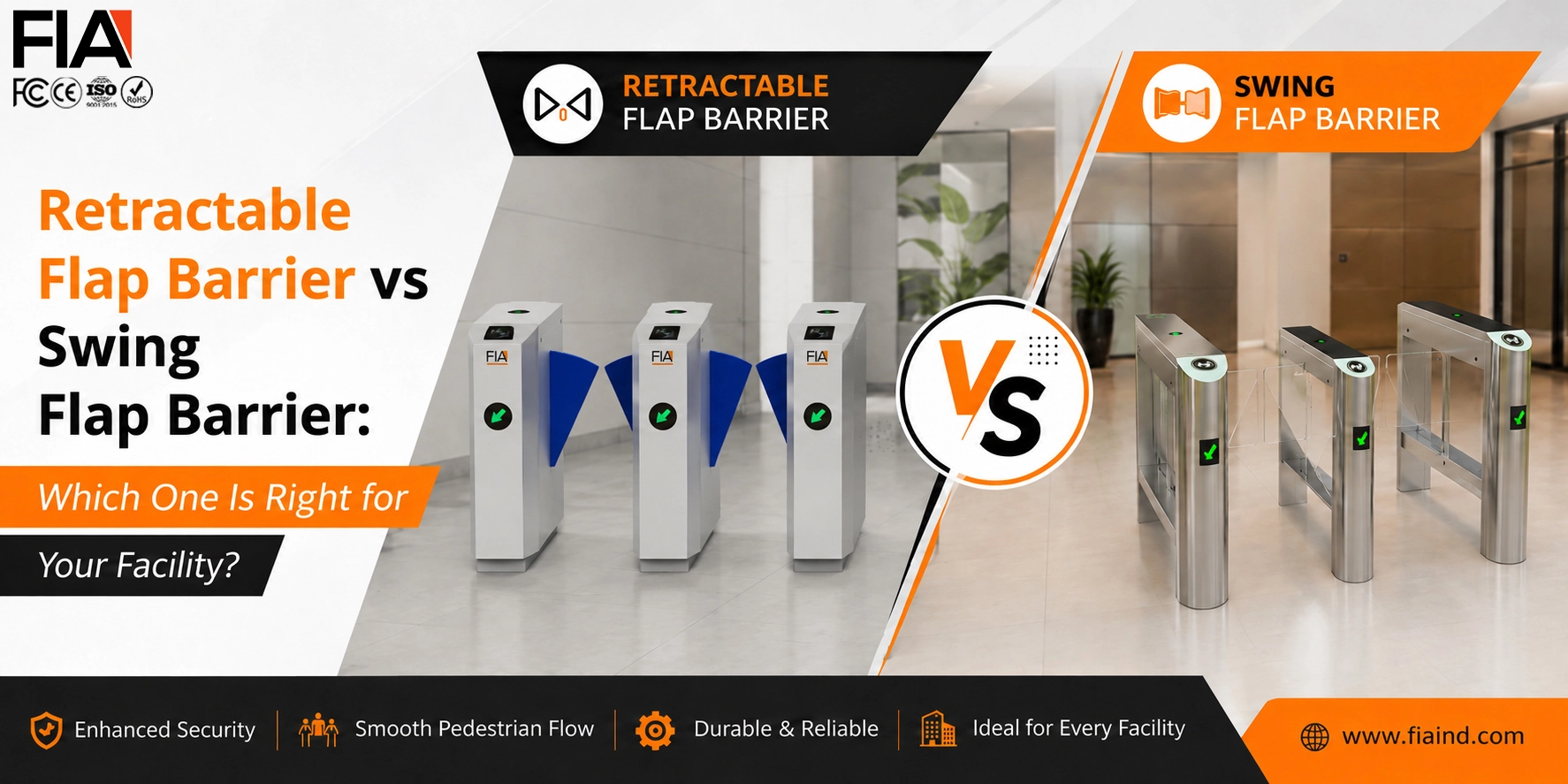
Choosing the right entrance control system is one of the most consequential decisions a facility manager, security head, or business owner will make. It affects everything from visitor experience to daily security posture to long-term maintenance costs. Among the many access control options available today, flap barriers stand out as one of the most popular choices for offices, metro stations, factories, stadiums, and residential complexes.
But within the flap barrier category itself, there are two dominant designs: the retractable flap barrier and the swing flap barrier. On the surface, they look similar — both use flap-style panels to control pedestrian flow, both integrate with access cards, biometric readers, and QR-based systems, and both offer a sleek, modern look compared to older turnstile designs. Look closer, though, and the differences become important, especially when you’re trying to match a system to your facility’s traffic, security requirements, and budget.
This guide breaks down exactly how retractable and swing flap barriers differ, where each one performs best, and how to decide which is the right fit for your facility.
What Is a Retractable Flap Barrier?
A retractable flap barrier uses one or two flap panels that slide horizontally into the barrier housing (the cabinet) when a valid credential is presented. Instead of swinging outward on a hinge, the flap retracts inward and disappears into the body of the unit, opening a clear passage lane. Once the person passes through, the flap slides back out to its closed position.
This retracting mechanism is typically driven by a linear motor or belt-drive system, which allows for very fast opening and closing cycles — often under 0.3 to 0.6 seconds per cycle in premium models.
Key Features of Retractable Flap Barriers
- Flaps disappear fully into the cabinet, leaving no protruding panel in the walkway
- High-speed opening and closing, suited to high-footfall environments
- Sleek, low-profile appearance that fits well in premium lobbies and modern architecture
- Anti-tailgating and anti-piggybacking sensors are easier to integrate due to the clean passage lane
- Generally quieter operation due to smooth linear mechanisms
What Is a Swing Flap Barrier?
A swing flap barrier, on the other hand, uses one or two flap panels mounted on a vertical hinge or pivot point. When a valid credential is presented, the flap swings open like a small door, rotating outward (or inward, depending on configuration) to allow passage. After the person passes, it swings back to the closed position.
This mechanism is mechanically simpler than the retractable design and has been in use for a longer period, making it a well-tested, widely manufactured option across price points.
Key Features of Swing Flap Barriers
- Simple pivot-based mechanism, generally easier and cheaper to manufacture and repair
- Sturdy physical barrier when closed, offering a strong visual and physical deterrent
- Widely available across a range of price points and brands
- Works well in low-to-medium footfall environments
- Slightly slower cycle time compared to retractable variants, though still fast enough for most everyday use
Retractable vs Swing Flap Barrier: Side-by-Side Comparison
| Parameter | Retractable Flap Barrier | Swing Flap Barrier |
|---|---|---|
| Mechanism | Flap slides into cabinet | Flap pivots on a hinge |
| Speed | Very fast (typically higher throughput) | Fast, slightly slower than retractable |
| Footprint in walkway | No flap intrusion into the passage lane | Flap may briefly intrude into adjacent lane while swinging |
| Noise level | Generally quieter | Can be slightly louder due to mechanical swing |
| Maintenance complexity | Moderate to higher (precision linear components) | Lower (simpler hinge mechanism) |
| Cost | Typically higher upfront cost | Typically more budget-friendly |
| Aesthetic | Sleek, modern, minimal visual footprint | Solid, robust, visibly present barrier |
| Best suited for | High-traffic corporate offices, metro stations, airports | Factories, warehouses, educational institutes, mid-traffic offices |
| Security deterrence | High, especially with tailgating sensors | High, due to physical swinging panel presence |
Security Considerations
Security is often the primary reason facilities install flap barriers in the first place, so it’s worth examining how each design holds up.
Retractable flap barriers are excellent at preventing tailgating in high-traffic zones because the barrier retracts and extends quickly, closing the gap almost instantly after an authorized person passes. Many models integrate infrared sensor arrays that detect unauthorized attempts to slip through, triggering an alarm and holding the flap in place.
Swing flap barriers offer a slightly different security advantage: because the flap physically swings into the passage space, it creates a more obvious and tactile obstruction. This can act as a stronger visual deterrent in environments where people may be less familiar with automated access systems, such as schools, gated communities, or industrial sites with a mixed workforce.
Neither design is inherently “more secure” in isolation — the right choice depends on how the barrier is integrated with your access control software, CCTV, and alarm systems, and how well it’s calibrated to your facility’s traffic patterns.
Traffic Flow and Speed
If your facility deals with rush-hour style traffic — such as metro stations, large corporate campuses, or event venues — the retractable flap barrier’s faster cycle time can make a measurable difference. Even a fraction of a second saved per person adds up significantly when hundreds or thousands of people pass through in a short window.
For facilities with steadier, moderate footfall — such as mid-sized offices, schools, or manufacturing units — a swing flap barrier typically provides more than enough throughput without the added cost of high-speed retractable mechanisms.
Maintenance and Total Cost of Ownership
Swing flap barriers, owing to their simpler mechanical design, are generally easier to service and repair. Replacement parts like hinges and actuators are widely available, and technicians can often resolve issues faster.
Retractable flap barriers, while more sophisticated, involve more precise components — linear motors, belts, and sliding mechanisms — which can mean higher servicing costs over the barrier’s lifetime, along with a higher initial purchase price. However, many facilities find that the improved user experience, aesthetics, and throughput justify this investment, particularly in premium or high-visibility locations like corporate headquarters and airports.
Aesthetic and Space Considerations
Architecture and interior design matter more than many facility managers initially expect. A retractable flap barrier, with its disappearing panel, tends to suit modern glass-and-steel lobbies, high-end office parks, and spaces where a minimalist look is a priority.
A swing flap barrier, being a bit more visually substantial, often fits naturally into industrial, institutional, or high-security environments where the presence of a physical barrier is seen as reassuring rather than obtrusive.
Space is another factor: retractable systems typically don’t require flap clearance into the adjoining lane, making them a better fit for narrower walkways or multi-lane configurations where lanes sit close together.
Which One Should You Choose?
Here’s a simple way to think about it:
Choose a Retractable Flap Barrier if:
- Your facility experiences high or peak-hour foot traffic
- You want a premium, modern aesthetic
- Lane space is limited and you need multiple lanes close together
- Noise levels and smooth user experience are a priority
- Budget allows for a higher upfront investment
Choose a Swing Flap Barrier if:
- Your facility has moderate, steady foot traffic
- You want a cost-effective, easy-to-maintain solution
- A strong physical/visual deterrent is a priority
- You’re deploying across multiple sites and need widely available spare parts
- You want a reliable, well-tested mechanism with a long track record
Final Thoughts
Both retractable and swing flap barriers are proven, reliable solutions for pedestrian access control, and the “better” option really comes down to matching the barrier’s strengths to your facility’s specific needs — traffic volume, budget, security priorities, and architectural style all play a role.
At First Idea Automation (FIA), we work closely with facility managers, architects, and security teams to evaluate these exact factors before recommending a system. Whether you’re securing a corporate headquarters, a metro station, an educational campus, or an industrial facility, getting this decision right from the start saves both cost and operational headaches down the line.
If you’re still unsure which barrier suits your facility, our access control specialists can assess your site’s traffic patterns, entry points, and security requirements, and recommend a solution tailored to your exact needs.
Frequently Asked Questions
1. Which is faster, a retractable or swing flap barrier? Retractable flap barriers generally have faster opening and closing cycles because the flap slides into the cabinet rather than pivoting outward, making them better suited for high-traffic environments.
2. Are swing flap barriers less secure than retractable ones? Not necessarily. Swing flap barriers offer strong physical deterrence due to the visible swinging panel, while retractable barriers rely more on sensor-based tailgating detection. Security depends on integration with your overall access control system, not just the mechanism type.
3. Which barrier requires less maintenance? Swing flap barriers typically have simpler mechanisms and are easier and cheaper to maintain compared to retractable flap barriers, which use more precise sliding components.
4. Can both types integrate with biometric and card-based access systems? Yes. Both retractable and swing flap barriers are compatible with RFID cards, biometric readers, QR code scanners, and facial recognition systems, and can be integrated into a centralized access control platform.
5. Which is more cost-effective for a small business? Swing flap barriers are usually the more budget-friendly option for small to mid-sized facilities with moderate footfall, while retractable barriers are better suited to larger facilities that need to justify a higher investment with higher throughput demands.