
With increasing concerns around vehicle-based threats, perimeter breaches, and traffic congestion, modern infrastructure demands smarter and more reliable vehicle access control systems. Whether it is a corporate campus, residential society, government building, airport, hotel, or high-security zone, controlling vehicle entry is no longer just about convenience — it is about security, safety, and risk mitigation.
Two of the most widely deployed vehicle access control solutions today are Automatic Rising Bollards and Boom Barrier Systems. While both are used to manage vehicle movement, their purpose, strength, design philosophy, and application areas are fundamentally different.
First Idea Automation offers a comprehensive range of automatic rising bollards and boom barrier systems, designed to work independently or as part of a layered security ecosystem. This blog explains the difference between automatic rising bollards and boom barriers, their applications, benefits, limitations, and helps you decide which solution is better for your vehicle access control requirement.
Understanding Vehicle Access Control Systems
A vehicle access control system is designed to:
- Regulate vehicle entry and exit
- Prevent unauthorized access
- Control traffic flow
- Protect sensitive perimeters
- Mitigate forced-entry threats
However, not all access control devices serve the same purpose. Some are designed for traffic regulation, while others are meant for physical vehicle stopping and impact resistance.
This is where the distinction between boom barriers and automatic rising bollards becomes critical.
What Is an Automatic Rising Bollard?
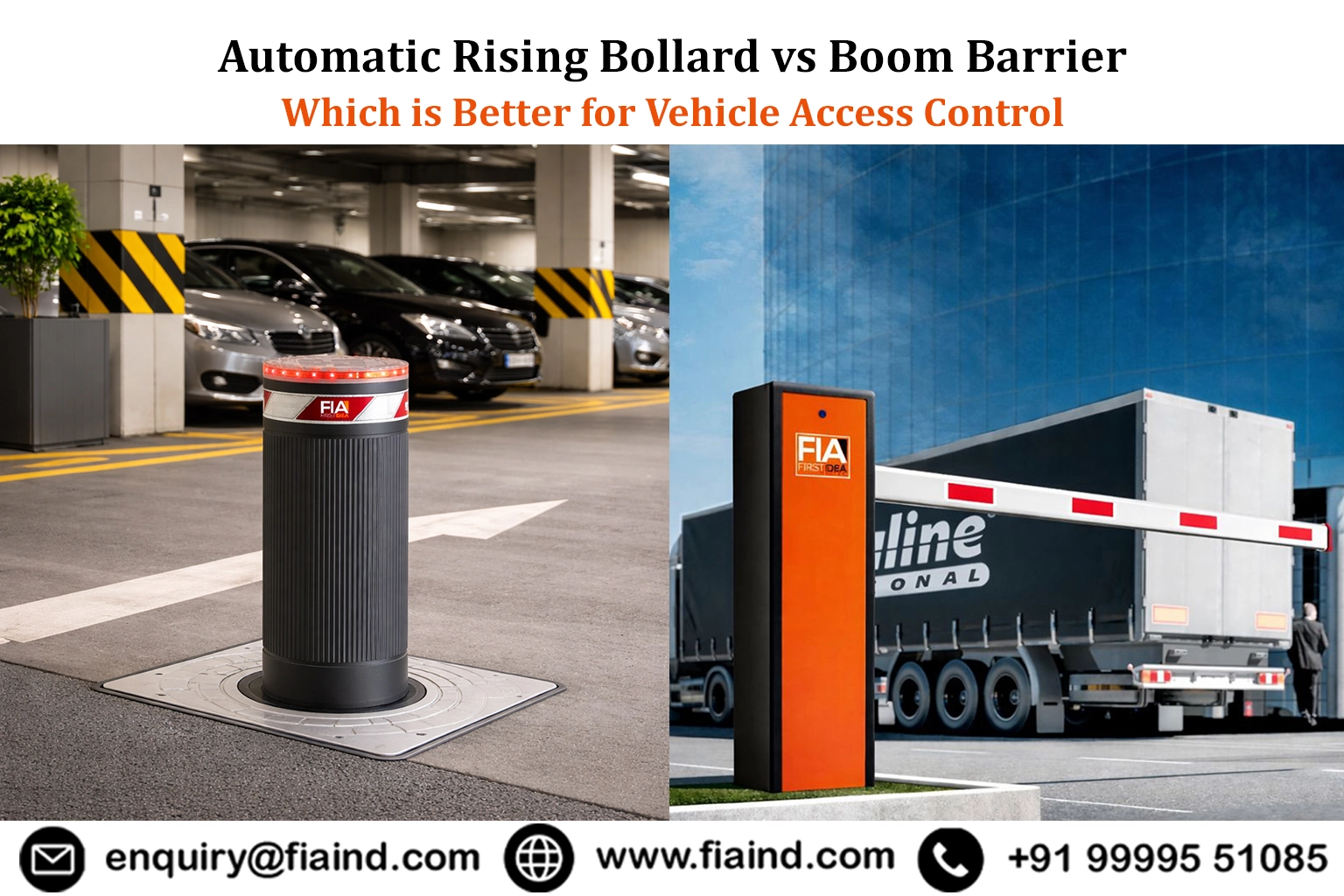
An automatic rising bollard, also known as a hydraulic rising bollard, is a high-security vehicle barrier designed to physically stop or disable a vehicle attempting forced entry.
Key Characteristics of Automatic Rising Bollards
- Heavy-duty steel or cast iron construction
- Hydraulic or electro-hydraulic mechanism
- Designed to rise vertically from the ground
- Capable of stopping high-speed vehicles
- Often crash-rated (K4, K8, K12)
- Installed flush with road surface when lowered
Unlike visual deterrents, rising bollards provide actual physical resistance against vehicle impact.
Construction & Design of Rising Bollards
First Idea Automation rising bollards are built with:
- High-strength steel or cast iron outer body
- Wall thickness options: 6 mm, 10 mm, 15 mm, up to 25 mm
- Bollard diameters: 220 mm and 275 mm
- Heights ranging from 600 mm to 1000 mm
As the height and thickness increase, the bollard’s ability to absorb impact and stop vehicles improves significantly.
Crash Rating Explained (K4, K8, K12)
Crash ratings define the ability of a bollard to stop a vehicle of a certain weight at a specific speed:
- K4 – Stops a light vehicle at moderate speed
- K8 – Stops heavier vehicles at higher speed
- K12 – Stops heavy trucks at very high speed
Most defense installations, embassies, and high-threat zones require K8 or K12 crash-rated bollards.
What Is a Boom Barrier?
A boom barrier is an electromechanical access control device that uses an aluminium or steel boom arm to regulate vehicle movement.
Key Characteristics of Boom Barriers
- Aluminium boom arm (3–8 meters)
- Electromechanical operation
- Designed for traffic regulation
- Fast opening and closing
- Visual deterrent, not impact-resistant
- Often equipped with swing-away arms
Boom barriers are designed to control traffic flow, not to stop a vehicle by force.
Construction & Operation of Boom Barriers
Boom barriers from First Idea Automation feature:
- Aluminium or lightweight steel boom arms
- Encoder-based motor control
- Adjustable speed
- Swing-away arm mechanisms
- Safety sensors and loop detectors
The swing-away arm protects the barrier in case a vehicle hits it, but this also means the barrier cannot stop an aggressive vehicle.
Core Difference: Security vs Traffic Control
| Aspect | Automatic Rising Bollard | Boom Barrier |
| Primary Purpose | High-security vehicle stopping | Traffic regulation |
| Impact Resistance | Very high | Very low |
| Crash Rating | K4 / K8 / K12 | Not crash-rated |
| Construction | Heavy steel / cast iron | Aluminium arm |
| Forced Entry Prevention | Yes | No |
| Visual Deterrence | Yes | Yes |
| Physical Stopping Power | Yes | No |
Application Areas of Boom Barriers
Boom barriers are ideal where:
- Traffic needs to be regulated
- Vehicle flow must be managed
- No high-impact threat exists
Common Applications
- Residential societies
- Corporate offices
- Parking facilities
- Warehouses & logistics hubs
- Hotels & hospitals
- Industrial campuses
- Highway toll lanes
Boom barriers ensure orderly movement, not security enforcement.
Application Areas of Automatic Rising Bollards
Automatic rising bollards are essential where:
- Vehicle-borne threats are possible
- Forced entry must be prevented
- High-value assets or people are at risk
Common Applications
- Defense establishments
- Government buildings
- Embassies & consulates
- High-security corporate offices
- Airports & VIP zones
- Five-star hotels
- Data centers
- Power plants
Here, physical stopping power is mandatory.
Why Boom Barriers Cannot Replace Rising Bollards
Boom barriers:
- Can be broken by vehicle impact
- Are designed to give way (swing-away)
- Do not offer crash resistance
- Are not designed for hostile environments
Therefore, boom barriers alone are not suitable for high-risk areas.
Why Rising Bollards Cannot Replace Boom Barriers Everywhere
Rising bollards:
- Are expensive
- Require civil foundation work
- Are slower than boom barriers
- Are overkill for low-risk areas
Hence, for normal parking and traffic management, boom barriers remain the most practical solution.
Integrated Solution: Boom Barrier + Rising Bollard
The most effective vehicle access control strategy is layered security.
How Integration Works
- Boom barrier regulates normal traffic
- Rising bollard stays lowered during routine operations
- If a vehicle attempts forced entry:
- Boom barrier arm breaks or is bypassed
- Rising bollard instantly rises
- Vehicle is physically stopped
This creates a dual-layer or triple-layer security system.
Integration Capabilities from First Idea Automation
First Idea Automation provides:
- Intelligent control units
- Seamless integration between bollards and boom barriers
- Emergency logic programming
- Centralized control panels
Supported Integrations
- Loop detectors
- Safety sensors
- IR beams
- Traffic lights
- Hooters and flashing lamps
- RFID readers
- Access control systems
Automation & Control Intelligence
Both systems from First Idea Automation feature:
- Smart control boards
- Adjustable operation speed
- Manual override options
- Emergency lowering and lifting
- Remote control and push-button operation
This ensures reliable operation even during emergencies.
Cost Consideration: Bollard vs Boom Barrier
| Factor | Rising Bollard | Boom Barrier |
| Initial Cost | High | Moderate |
| Installation | Civil-intensive | Simple |
| Maintenance | Moderate | Low |
| Security Value | Very High | Low |
| Traffic Control | Moderate | Excellent |
Which Is Better for Vehicle Access Control?
The answer depends on risk level:
- Low-risk environments → Boom Barrier
- Medium-risk environments → Boom Barrier + Access Control
- High-risk environments → Automatic Rising Bollard
- Critical security zones → Boom Barrier + Rising Bollard
Why Choose First Idea Automation
First Idea Automation offers:
- Wide range of boom barriers
- Hydraulic & electro-hydraulic rising bollards
- Crash-rated security solutions
- Intelligent integration capability
- Proven deployment experience
- End-to-end vehicle access control expertise
Conclusion
Automatic rising bollards and boom barriers serve very different purposes in vehicle access control. While boom barriers excel in traffic regulation, rising bollards provide unmatched physical security.
Rather than choosing one over the other, modern security design favors integrated solutions, where First Idea Automation delivers a complete, intelligent, and future-ready ecosystem for vehicle access control, traffic management, and perimeter security.