
Introduction
When it comes to securing a commercial complex, parking facility, toll plaza, or gated community, an automatic boom barrier system is one of the most reliable and cost-effective solutions available. But not all boom barriers are created equal. Choosing the wrong system can lead to frequent breakdowns, security gaps, slow vehicle throughput, and expensive maintenance cycles.
So, what separates a high-performance boom barrier from a substandard one?
In this guide, we break down the critical features to look for in an automatic boom barrier system — based on real-world installation experience, technical specifications, and end-user requirements across diverse industries. Whether you are procuring for a residential society, a corporate campus, or a high-security government facility, this checklist will help you make a well-informed decision.
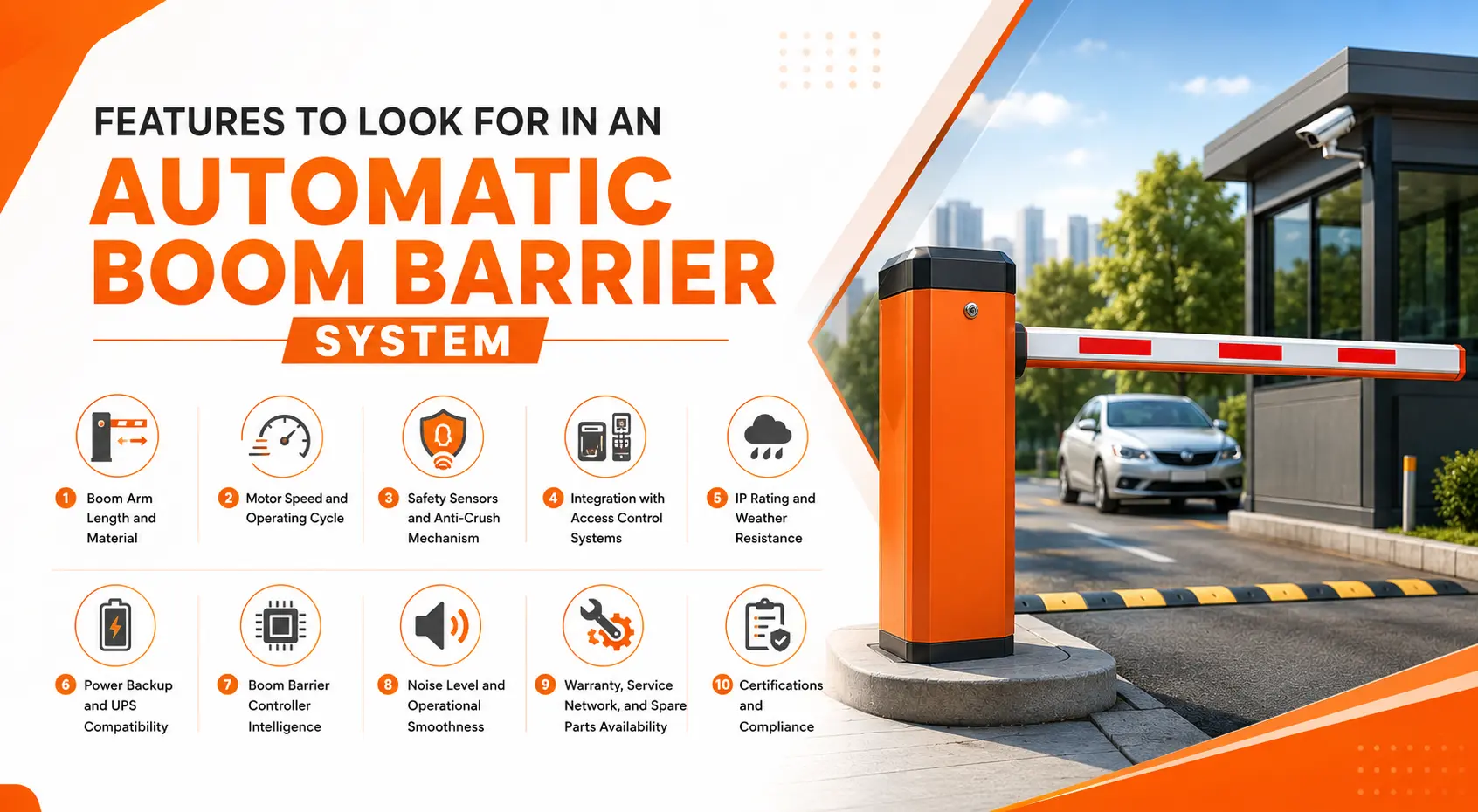
1. Boom Arm Length and Material
The first parameter to evaluate is the boom arm length and its construction material. Boom arms typically range from 1 metre to 8 metres or more, and the right length depends entirely on your lane width.
For standard single-lane applications, a 3–4 metre boom arm is sufficient. For wider toll lanes or vehicle checkpoints, arms extending to 6–8 metres are necessary. However, longer arms require stronger motors and reinforced joints to prevent sagging or vibration.
What to look for:
- Aluminium or fibreglass arms for lightweight, corrosion-resistant performance
- Counterbalance mechanisms that reduce motor strain
- Optional rubber skirts or safety strips at the tip to prevent vehicle damage
- Articulated arms (fold-up design) for low-ceiling parking structures
Avoid systems with arms made solely of heavy steel without counterweights — they place excessive load on the motor and reduce operational lifespan.
2. Motor Speed and Operating Cycle
The opening and closing speed of a boom barrier directly impacts vehicle throughput — especially in high-traffic environments like malls, hospitals, and corporate parks during peak hours.
Most standard boom barriers operate at a speed of 3–6 seconds per cycle. High-speed variants can complete a full open-close cycle in under 1.5 seconds, making them suitable for fast-lane toll applications or high-frequency entry points.
Key parameters to compare:
- Full open-to-close time (in seconds)
- Rated duty cycle — expressed as operations per hour (e.g., 360, 600, or up to 900 cycles/hour)
- Continuous duty motor rating for 24/7 deployment
For a busy commercial parking facility, select a system rated for at least 600 operations per hour to avoid motor overheating and premature failure.
3. Safety Sensors and Anti-Crush Mechanism
This is arguably the most important safety feature in any automatic boom barrier system. A boom closing on a vehicle — or worse, a pedestrian — can cause serious damage and legal liability.
A quality system must include:
- Infrared (IR) loop sensors or ground induction loops that detect vehicle presence beneath the arm and prevent closure until the vehicle has cleared
- Obstacle detection via pressure or torque sensing — the motor reverses immediately if unexpected resistance is encountered during closing
- Warning lights and audible buzzers that alert drivers and pedestrians when the arm is about to move
- Emergency manual release for power outages or system failure
Do not compromise on this feature. Any barrier system without active anti-crush protection poses a real safety and insurance risk.
4. Integration with Access Control Systems
A standalone boom barrier is only part of the solution. In modern facilities, boom barriers must seamlessly integrate with a broader access control ecosystem. Look for compatibility with:
- RFID card readers and transponders for contactless vehicle authentication
- Automatic Number Plate Recognition (ANPR/LPR) cameras for vehicle whitelist/blacklist enforcement
- Intercom and video surveillance systems for manned guard integration
- Parking management software that tracks entry/exit logs, occupancy, and billing
- Boom barrier controllers with open API or Wiegand/RS-485 interface for third-party integration
At First Idea Automation, we deploy boom barriers as part of integrated smart access control systems — ensuring your hardware investment supports your broader security architecture today and in the future.
5. IP Rating and Weather Resistance
India’s climate demands that any outdoor electromechanical equipment be built for harsh conditions — extreme heat, monsoon rains, dust, and humidity. The Ingress Protection (IP) rating of the boom barrier’s cabinet tells you exactly how well it is sealed.
Recommended minimum ratings:
- IP54 — Protected against dust ingress and water splashing from any direction; suitable for most outdoor installations
- IP65 or higher — Fully dust-tight and protected against low-pressure water jets; recommended for coastal or high-rainfall regions
Also check:
- Operating temperature range (should support at least -10°C to +60°C)
- UV-stabilised cabinet coatings to prevent fading and corrosion
- Stainless steel or powder-coated housing for extended outdoor life
A boom barrier rated IP44 or below is not suitable for permanent outdoor deployment in Indian conditions.
6. Power Backup and UPS Compatibility
Power cuts are common across many parts of India and pose a critical vulnerability for access-controlled facilities. An automatic boom barrier system must either include or support uninterruptible power supply (UPS) backup.
Features to verify:
- Built-in battery backup that keeps the system operational for a minimum of 4–8 hours during a power outage
- Automatic detection of power failure with switchover to battery
- Manual crank or push-to-open failsafe that works without power
- Compatibility with external UPS or solar power supply for off-grid installations
Without proper power backup, a power failure could lock your facility or, worse, leave it completely open and unsecured.
7. Boom Barrier Controller Intelligence
Modern boom barrier systems are driven by embedded controllers that manage all logic — from input commands and safety overrides to loop sensor integration and diagnostic alerts. The quality of this controller determines long-term reliability.
Evaluate the controller for:
- Adjustable arm speed settings (separate open and close speeds)
- Configurable dwell time (how long the arm stays open before auto-closing)
- Anti-tailgating logic (immediate re-close after one vehicle detection)
- Error logging and diagnostic LED indicators
- Remote monitoring capability via GSM, Ethernet, or RS-485
Advanced controllers can even integrate with smart city platforms or facility management dashboards, giving security managers real-time visibility into barrier status and usage data.
8. Noise Level and Operational Smoothness
In residential societies, hospitals, and premium commercial properties, noise pollution from mechanical equipment is a genuine concern. Cheap boom barriers often produce loud clicks, bangs, or motor hum during operation.
Look for:
- Brushless DC motors or AC motors with soft-start/soft-stop technology
- Dampened mechanical stops to cushion the arm at the end of travel
- Low dB operating noise (ideally under 55 dB at 1 metre distance)
- Smooth ramp-up and ramp-down motion profiles (not abrupt starts and stops)
A quiet, smooth boom barrier also signals build quality — it reflects tighter tolerances, better motor control, and longer component life.
9. Warranty, Service Network, and Spare Parts Availability
Even the best boom barrier system will eventually require maintenance or component replacement. Before finalising any purchase, evaluate the after-sales support ecosystem:
- Minimum 2-year on-site warranty on the full system
- Readily available spare parts (motors, control boards, arms, sensors)
- Certified service engineers in your region with guaranteed response time
- Preventive maintenance (AMC) packages offered by the supplier
- Remote diagnostics support to resolve software issues without on-site visits
A barrier system from a supplier with no local service network can become a liability the moment something goes wrong. At First Idea Automation, we back every installation with trained field engineers and a strong spare parts supply chain across our service regions.
10. Certifications and Compliance
For government, institutional, and large-scale commercial projects, the boom barrier system may need to meet specific standards and certifications:
- CE marking — Confirms compliance with European safety, health, and environmental standards (widely accepted as a quality benchmark globally)
- ISO 9001-certified manufacturing for consistent quality control
- IEC 60529 compliance for IP rating verification
- RoHS compliance — Ensures the system is free from hazardous substances
Always ask your supplier for product certifications and test reports. Reputable manufacturers will have these readily available.
Quick Comparison: Features Checklist
| Feature | Basic Requirement | Premium Standard |
|---|---|---|
| Boom Arm Length | Up to 4 m | Up to 8 m (articulated) |
| Operating Speed | 3–6 seconds | Under 2 seconds |
| Duty Cycle | 360 ops/hour | 600–900 ops/hour |
| IP Rating | IP54 | IP65+ |
| Safety Sensor | IR loop sensor | Loop + torque sensing |
| Power Backup | Manual release | 4–8 hrs battery UPS |
| Integration | Standalone | RFID + ANPR + Software |
| Warranty | 1 year | 2+ years with AMC |
Frequently Asked Questions (FAQ)
Q: What is the typical lifespan of an automatic boom barrier system? A: A well-maintained boom barrier system from a reputable manufacturer typically lasts 7–12 years, depending on usage intensity, environmental conditions, and adherence to a preventive maintenance schedule.
Q: Can a boom barrier work with solar power? A: Yes. Many modern boom barrier systems are compatible with solar power supply with battery storage, making them ideal for remote locations or facilities aiming to reduce grid dependency.
Q: How do I choose between a 3-metre and a 6-metre boom arm? A: Measure your lane width. The boom arm should span the full lane width with a small clearance on each side. For standard single-lane roads (3–3.5 m wide), a 3–4 m arm is standard. For dual-lane or wide entry roads, opt for 5–6 m arms.
Q: What happens to the boom barrier during a power failure? A: Systems with built-in battery backup continue operating normally. Systems with only a manual release will need to be opened manually by a guard. Always specify power backup as a requirement during procurement.
Q: Is ANPR integration worth the added cost? A: For facilities with high vehicle volumes or those requiring automated access without physical card readers, ANPR integration provides significant operational value — reducing queues, eliminating card issuance overhead, and providing automatic audit trails.
Conclusion
Choosing the right automatic boom barrier system is not just about upfront cost — it is a long-term investment in the safety, efficiency, and professionalism of your facility. The features outlined in this guide — from motor speed and safety sensors to IP ratings, integration capability, and after-sales support — form the foundation of a reliable, future-ready system.
At First Idea Automation, we engineer and install boom barrier solutions tailored to the specific demands of your site — whether it is a residential gate, a corporate campus, a toll plaza, or a high-security perimeter. Our systems are backed by technical expertise, certified components, and a service network that ensures your investment stays operational for years to come.
Ready to get started? Contact our team today for a free site assessment and customised boom barrier recommendation.