
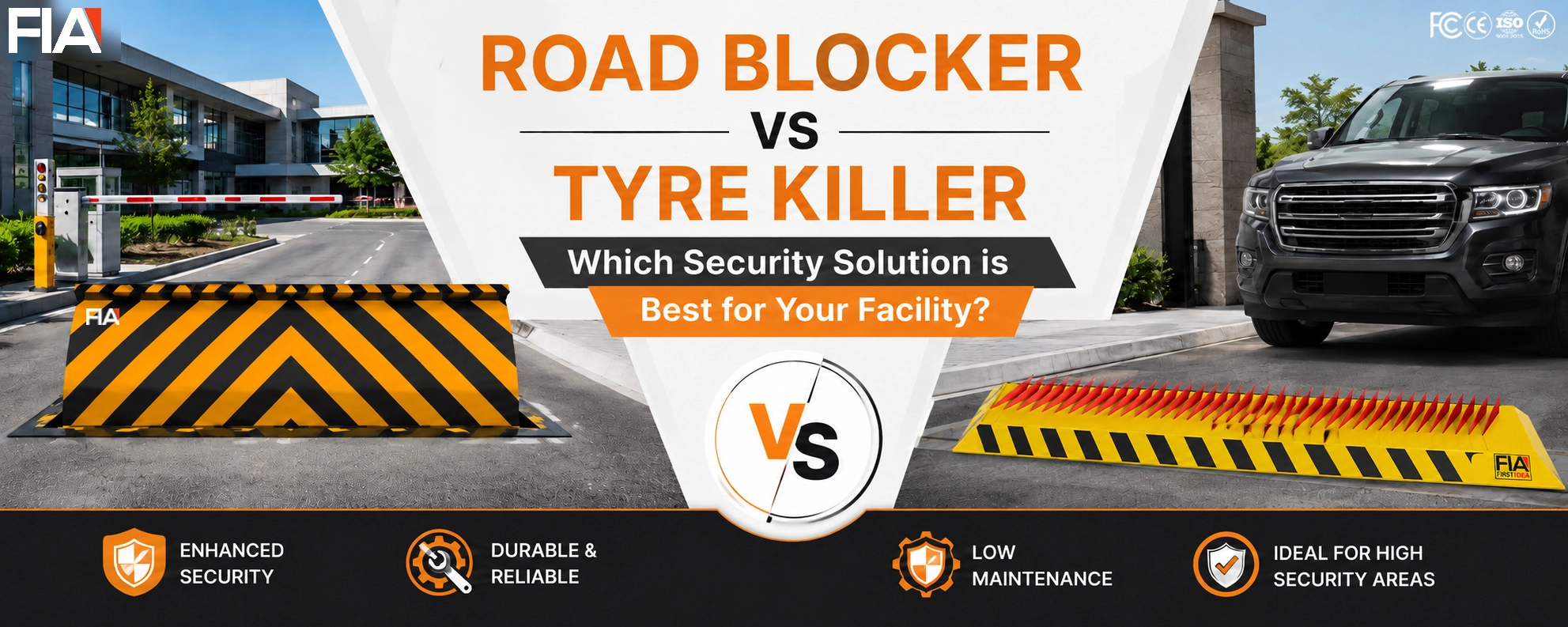
Vehicle-borne threats have become one of the most serious concerns for high-security sites, commercial premises, and public infrastructure. Whether it’s an embassy guarding against a ramming attack or a corporate campus managing everyday traffic flow, choosing the right perimeter security equipment is no longer optional — it’s essential.
Two of the most widely used hostile vehicle mitigation (HVM) solutions are road blockers & tyre killers. Both are designed to stop unauthorized vehicles, but they work in fundamentally different ways, serve different threat levels, and suit different types of facilities. Understanding these differences will help you make an informed decision that balances security, budget, and operational needs.
In this guide, we break down how each system works, where they perform best, and how to decide which one — or combination of both — is right for your facility.
What is a Road Blocker?
A road blocker is a heavy-duty steel barrier that rises vertically or at an incline from the ground to form a solid physical wall across a roadway. When deployed, it is designed to absorb and neutralize the full kinetic energy of an oncoming vehicle, bringing it to a complete stop rather than simply slowing it down.
Most road blockers are hydraulically operated, though electromechanical variants also exist for lower-traffic applications. High-security models are tested and certified against internationally recognized crash standards such as PAS 68, IWA 14, and ASTM F2656. The highest-rated units can stop a fully loaded truck weighing several tonnes travelling at high speed, with little to no penetration past the barrier line.
Because of their mass and engineering, road blockers require solid foundation work during installation — typically a shallow or deep pit for the hydraulic housing and support frame. Once installed, however, they require relatively low ongoing maintenance beyond periodic checks of the hydraulic and electrical systems.
Best suited for: embassies, military installations, government buildings, airports, data centers, nuclear facilities, and any site where absolute vehicle stoppage is a non-negotiable requirement.
What is a Tyre Killer?
A tyre killer, also known as a spike barrier, uses a row of retractable steel spikes or blades that rise from the road surface to puncture and shred the tyres of an unauthorized vehicle. Rather than stopping the vehicle outright on impact, a tyre killer disables its mobility, forcing it to slow down and eventually come to a halt.
Tyre killers are available in hydraulic, electromechanical, and manual or spring-loaded configurations. Because the moving components are lighter than a road blocker’s steel wedge, they typically deploy and retract faster, making them well suited to locations with frequent vehicle movement. In their resting position, most tyre killers sit flush with the ground and resemble a speed bump, giving them a lower visual profile than a road blocker.
Installation is generally simpler and requires less excavation, which makes tyre killers a practical choice for sites with space or budget constraints, or where retrofitting a barrier into an existing road surface is necessary.
Best suited for: car parks, toll plazas, border checkpoints, gated communities, warehouses, one-way traffic control points, and facilities with moderate rather than extreme threat levels.
Key Differences Between Road Blockers and Tyre Killers
1. Impact Resistance and Threat Level
This is the most important distinction for any security planner. Road blockers are engineered to physically halt a vehicle’s momentum, including determined high-speed ramming attempts. Crash-rated units can stop vehicles weighing thousands of kilograms at highway speeds, making them the preferred choice wherever a worst-case attack scenario must be planned for.
Tyre killers, by contrast, disable a vehicle by targeting its tyres rather than absorbing the vehicle’s full force. They are highly effective against unauthorized access attempts, tailgating, and low-to-moderate speed intrusions, but a very heavy or fast-moving vehicle may still travel some distance after the tyres are punctured before it loses control. For this reason, tyre killers are generally classified as a deterrent and access-control device rather than a maximum-security anti-ram barrier.
2. Deployment Speed
Tyre killers, due to their lighter moving parts, can typically raise or lower within one to two seconds, which supports smoother traffic flow at busy access points. Road blockers, moving a much heavier steel structure, usually take longer to deploy — often in the range of three to five seconds — although many premium models now include emergency fast-raise systems that can close the barrier in under two seconds when triggered by an intrusion sensor.
3. Installation and Civil Work
Road blockers demand more substantial civil engineering work, including deeper foundations to house the hydraulic mechanism and withstand impact forces. This translates into longer installation timelines and higher upfront costs. Tyre killers require comparatively minimal excavation, and some surface-mounted models can be installed with very little disruption to existing infrastructure, which is a major advantage for facilities looking to upgrade security without a lengthy construction project.
4. Visual Deterrence and Aesthetics
A fully raised road blocker presents an imposing, unmistakable barrier that offers strong psychological deterrence on its own. Tyre killers are more discreet in their resting state, blending in as a low-profile ground fixture, though the sight of deployed spikes is itself a clear warning to any driver approaching without authorization.
5. Operational Flexibility
Tyre killers are often used to enforce one-way traffic — allowing vehicles to pass safely in one direction while preventing reverse or unauthorized entry — and can be relocated or reconfigured with relatively less effort than a road blocker. Road blockers are generally installed as permanent, fixed-position assets due to the scale of their foundation work, making them less flexible but far more robust once in place.
6. Maintenance and Lifecycle Costs
Road blockers, once installed, tend to need only routine hydraulic and electrical inspections, since they have fewer exposed moving parts that interact directly with vehicles. Tyre killers, with spikes that make direct contact with tyres and road debris, may require more frequent inspection and part replacement, particularly in high-traffic environments.
7. Cost Considerations
Road blockers are typically the more expensive option overall, driven by the equipment’s engineering complexity, the civil works required, and the crash-rating certification process. Tyre killers are generally more affordable and quicker to deploy, though heavy-duty or highly automated models with camera integration and license plate recognition can narrow that cost gap considerably.
Which One Should You Choose?
The right choice ultimately comes down to a clear-eyed assessment of your facility’s threat profile, traffic patterns, and budget. Here’s a practical way to think about it:
Choose a road blocker if:
- Your facility faces a genuine risk of vehicle-borne attack (government buildings, embassies, critical infrastructure, defense sites)
- You need certified, crash-tested protection against high-speed, heavy-vehicle threats
- Vehicle throughput at the access point is relatively low, so slightly slower deployment isn’t a bottleneck
- Long-term durability and maximum stopping power outweigh installation cost and complexity
Choose a tyre killer if:
- Your primary concern is controlling unauthorized access or enforcing one-way traffic rather than defending against ramming attacks
- You need faster cycle times to keep traffic moving at busy entry and exit points
- Installation budget or site constraints rule out extensive excavation
- The facility’s risk profile is moderate — for example, a corporate car park, residential gated community, or toll booth
Consider a layered approach: Many high-security sites don’t rely on a single solution. It’s increasingly common to see road blockers deployed at primary vehicle entry points as the last line of defense, combined with tyre killers or bollards further along the approach to manage traffic flow, enforce lane discipline, and add an additional layer of deterrence before a vehicle ever reaches the main barrier.
Final Thoughts
Both road blockers and tyre killers play a vital role in modern perimeter security, but they are not interchangeable. Road blockers deliver maximum, certified protection against determined high-speed attacks, while tyre killers offer a faster, more cost-effective way to manage access and deter unauthorized entry at moderate-risk locations.
The best decision comes from a proper site risk assessment — considering the nature of potential threats, the volume of legitimate traffic, available space, and long-term budget. Consulting with a qualified perimeter security specialist can help you match the right equipment, or combination of equipment, to your facility’s exact requirements, ensuring you get robust, reliable protection without over- or under-investing in your security infrastructure.
If you’re evaluating security options for your site, our team can help assess your facility’s risk profile and recommend the right road blocker, tyre killer, or combined solution to keep your premises protected.