
Mumbai never sleeps. With over 20 million people navigating its offices, metro stations, residential complexes, and IT parks every single day, managing who enters and exits a premises is no longer a luxury it is a fundamental operational necessity. For businesses and facility managers across the city, flap barrier systems have emerged as one of the most reliable, efficient, and elegant solutions to modern access control challenges.
At First Idea Automation (FIA), we have been at the forefront of designing and deploying intelligent security infrastructure across Mumbai and Maharashtra. In this guide, we walk you through everything you need to know about flap barrier systems — how they work, where they are most effective, and why they have become the access control solution of choice for high-footfall environments in Mumbai.
What Is a Flap Barrier System?
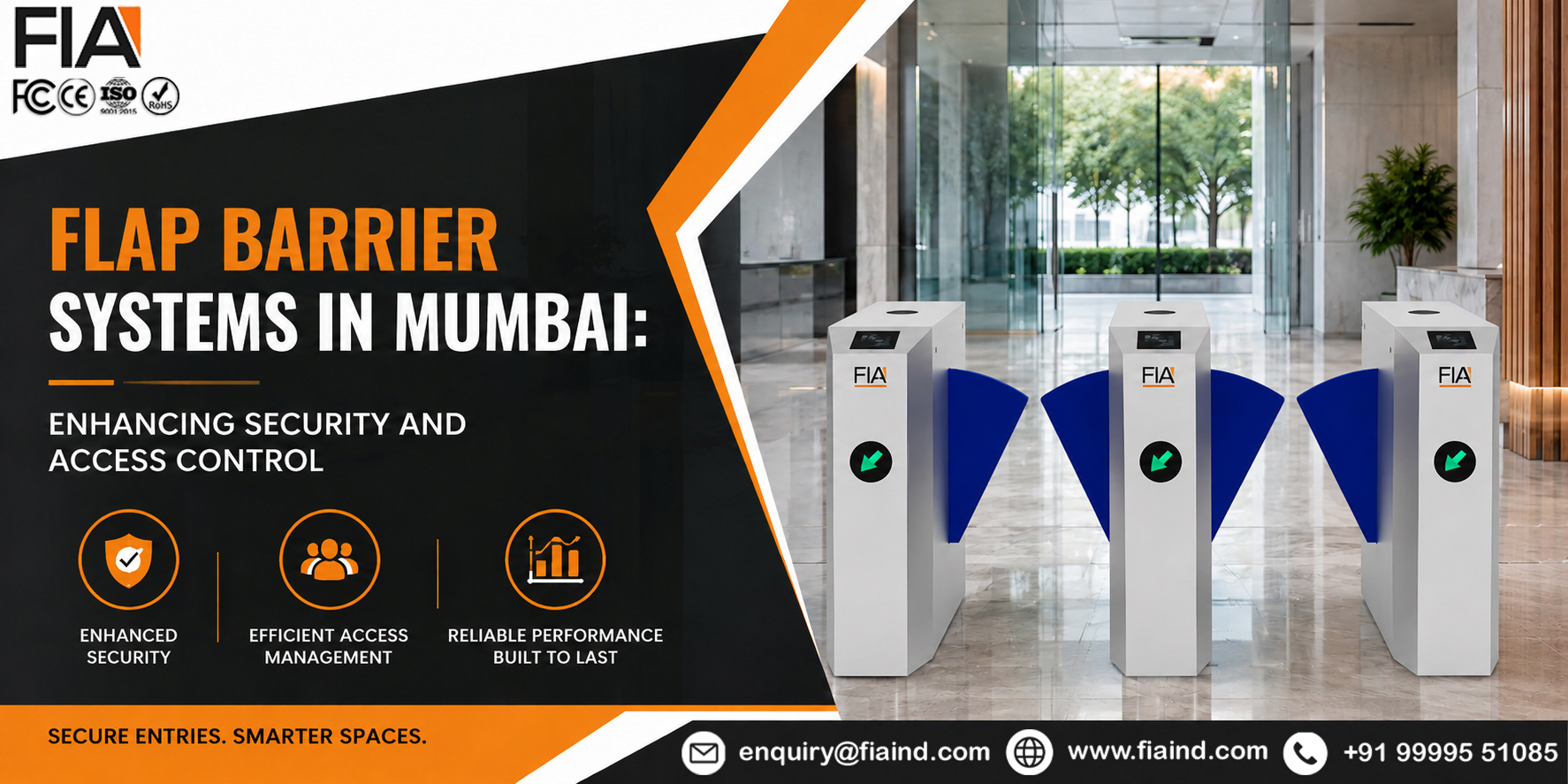
A flap barrier — sometimes called a swing barrier or paddle barrier — is a type of pedestrian access control gate that uses motorized retractable wings (flaps) to allow or deny entry to individuals. When an authorized credential is presented — such as an RFID card, biometric scan, QR code, or mobile app — the flap wings retract into the housing unit, allowing the person to pass through. Once the person has crossed, the flaps return to the closed position automatically.
Unlike traditional turnstiles that rotate, flap barriers offer a wider passageway. This makes them ADA-compliant (accessible for people with disabilities) and particularly suited for environments where a professional, unobtrusive aesthetic is important — like corporate lobbies, tech parks, and premium residential towers.
Why Mumbai Businesses Are Adopting Flap Barrier Systems
Mumbai is one of India’s most commercially dense cities. From Bandra-Kurla Complex (BKC) and Lower Parel to Powai and Navi Mumbai’s MIDC zones, thousands of commercial establishments deal with hundreds to thousands of employee and visitor movements daily. Here is why flap barriers have become the preferred solution:
1. High-Speed, High-Volume Throughput
Flap barriers are engineered for speed. A single lane can process up to 30–40 people per minute, making them ideal for Mumbai’s busy peak hours — whether it is the morning rush at a corporate campus or shift changeovers at a manufacturing facility. Delays at entry points translate directly into productivity loss, and flap barriers minimize that friction significantly.
2. Tailgating and Piggybacking Prevention
One of the most persistent security vulnerabilities in large facilities is tailgating — when an unauthorized individual slips through behind an authorized person. Modern flap barrier systems are equipped with infrared sensors and intelligent passage detection algorithms that trigger an alert or close the flaps if more than one person attempts to pass on a single credential. For data centers, pharma facilities, and financial institutions in Mumbai, this capability is non-negotiable.
3. Seamless Integration with Existing Security Systems
FIA’s flap barrier installations are designed to integrate smoothly with your existing infrastructure — whether that is your biometric attendance system, CCTV network, visitor management software, or fire alarm panel. In the event of a fire or emergency, barriers can be configured to fail-safe open, ensuring unobstructed evacuation.
4. Professional Aesthetics for Premium Spaces
Mumbai’s corporate real estate is increasingly world-class. A clunky, industrial-looking turnstile simply does not belong in the glass-and-steel lobby of a headquarters in BKC or a co-working space in Lower Parel. Flap barriers come in sleek stainless steel finishes, tempered glass panels, and slim-profile designs that complement premium interiors without compromising on security.
5. Durability in Mumbai’s Climate
Mumbai’s humidity, monsoon rains, and coastal air can be harsh on equipment. Industrial-grade flap barriers built for Indian conditions use corrosion-resistant materials, sealed motor housings, and dust-protected sensor arrays that perform reliably year-round — even during the June–September monsoon season.
Key Applications of Flap Barriers in Mumbai
Corporate Offices and IT Parks
Large IT parks in Powai, Malad, and Airoli manage thousands of employees across multiple shifts. Flap barriers at entry lobbies, parking access points, and server room corridors ensure that only credentialed personnel access specific zones. Combined with face recognition or fingerprint biometrics, they create a multi-layered security perimeter.
Metro Stations and Transit Hubs
Mumbai Metro has been a significant adopter of automated fare gate technology, with flap-style barriers now visible at several metro lines including Metro Line 1 (Versova–Ghatkopar) and expanding corridors. These systems manage millions of passenger movements with minimal staff intervention.
Educational Institutions
Universities, coaching institutes, and international schools in Mumbai use flap barriers to restrict campus access to enrolled students, faculty, and authorized visitors. Integration with student ID cards or mobile-based passes makes daily entry seamless while maintaining a verifiable entry log.
Hospitals and Healthcare Facilities
Hospitals present a unique challenge: the need for strict zone-based access (ICU, operation theatres, pharmacy) alongside compassionate, frictionless entry for patients and caregivers. Flap barriers at hospital zones help achieve this balance — ensuring only authorized medical staff access sensitive areas while keeping general movement smooth.
Residential Complexes and Gated Communities
Premium residential societies in Worli, Juhu, and Thane are increasingly installing flap barriers at clubhouses, gym entrances, and building lobbies to restrict access to registered residents and verified guests, replacing manual security checkpoints that are prone to human error.
Government and Defense Establishments
Secure government facilities in Mumbai require the highest level of access integrity. Flap barriers with multi-factor authentication (biometric + smart card) and anti-passback features ensure that entry logs are accurate and tamper-evident.
Features to Look for in a Flap Barrier System
If you are evaluating a flap barrier solution for your Mumbai facility, here are the critical specifications and features to assess:
- Passage Width: Standard lanes are 550–600 mm; wide-lane versions (900+ mm) accommodate wheelchair users and trolleys.
- Throughput Speed: Look for systems rated at 30–40 persons per minute per lane.
- Authentication Compatibility: Ensure support for RFID, QR code, biometric, and Bluetooth/mobile credentials.
- Anti-Tailgating Sensors: Infrared or laser-based dual-direction detection is essential for high-security environments.
- Fail-Safe and Fail-Secure Modes: Choose systems that support both modes and integrate with your fire alarm/BMS.
- IP Rating: For outdoor or semi-outdoor installations (parking plazas, covered walkways), look for IP54 or higher protection.
- Remote Management: Cloud-based or LAN-based software for real-time monitoring, access log reporting, and remote lane configuration.
- MTBF (Mean Time Between Failures): Reliable systems are rated for 5–10 million cycles before requiring major maintenance.
FIA’s Approach: From Consultation to Commissioning
At First Idea Automation, we believe that access control is not a product — it is a solution tailored to your specific environment, workflow, and risk profile. Our process follows a structured methodology:
1. Site Survey and Needs Assessment Our engineers conduct a detailed on-site evaluation of your facility’s entry/exit points, footfall patterns, existing IT infrastructure, and security vulnerabilities. This informs the lane count, authentication method, and integration requirements for your project.
2. Solution Design and Proposal We present a customized layout plan with product specifications, integration architecture, and total cost of ownership — not just the equipment price, but installation, training, and annual maintenance factored in transparently.
3. Professional Installation Our certified installation teams handle civil work coordination, electrical cabling, network setup, and barrier commissioning with minimal disruption to your ongoing operations.
4. Software Configuration and User Training Every deployment includes full software setup — access group configuration, shift schedules, visitor workflows, and reporting dashboards — along with hands-on training for your security and HR teams.
5. Post-Installation AMC (Annual Maintenance Contract) Mumbai’s high-footfall environments demand proactive maintenance. FIA’s AMC programs include scheduled preventive maintenance visits, priority breakdown response, remote diagnostics, and firmware updates to keep your system performing at peak efficiency.
Compliance and Standards
FIA’s flap barrier systems meet relevant Indian and international standards including:
- BIS (Bureau of Indian Standards) electrical safety compliance
- CE marking for electromagnetic compatibility
- ADA / RPWD Act 2016 accessibility guidelines for wide-lane configurations
- GDPR/PDPB alignment for biometric data handling within access control software
The ROI of Investing in Flap Barrier Systems
Security infrastructure is often viewed purely as a cost center. However, the return on investment from a well-deployed flap barrier system is measurable:
- Reduced Manpower Costs: A single automated lane replaces the need for a dedicated security guard at every entry point, yielding significant monthly savings in a city where security personnel costs are rising.
- Accurate Attendance Data: Integration with HRMS platforms eliminates buddy-punching and manual attendance errors, with tangible payroll savings.
- Insurance and Compliance Benefits: Demonstrable access control infrastructure can reduce commercial insurance premiums and satisfy regulatory audit requirements for industries like BFSI, pharma, and IT/ITES.
- Incident Liability Reduction: A verifiable, timestamped entry log is invaluable in the event of a security incident, theft, or workplace investigation.
Why Choose First Idea Automation?
FIA has delivered access control projects across Mumbai, Pune, Nashik, and beyond — serving clients in sectors ranging from banking and pharmaceuticals to logistics, education, and government. Our differentiators:
- Mumbai-based technical team with rapid deployment and support response
- Brand-agnostic recommendations — we recommend the right product for your application, not the one with the highest margin
- End-to-end ownership from design through AMC
- Proven track record with enterprise, mid-market, and institutional clients
Whether you are setting up a new facility or upgrading legacy turnstiles at an existing site, FIA brings the expertise to get it right — on time and within budget.
Ready to Secure Your Premises?
If your Mumbai facility is dealing with unauthorized access, inefficient entry management, or outdated security infrastructure, a flap barrier system from FIA could be the strategic upgrade you need.
Contact First Idea Automation today for a free site consultation and customized proposal. Our team is ready to help you design an access control solution that matches the pace and scale of Mumbai’s dynamic business environment.
First Idea Automation (FIA) is a Mumbai-based security and automation solutions provider specializing in access control, video surveillance, fire safety, and building automation systems. With years of hands-on experience across diverse industries, FIA delivers technology-driven security infrastructure built for Indian conditions.