
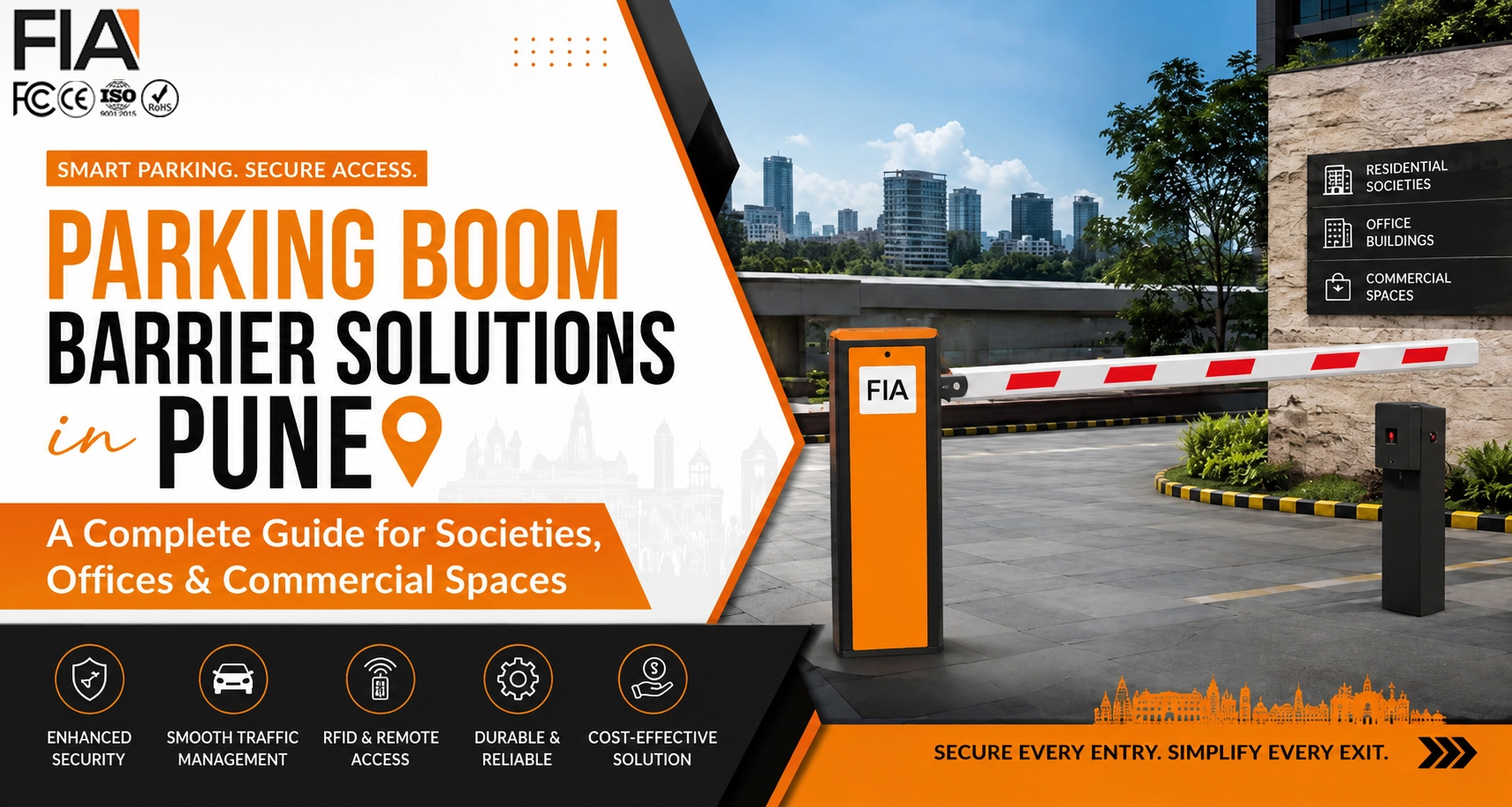
Pune’s skyline has changed dramatically over the last decade. IT parks in Hinjawadi, residential townships in Wagholi and Undri, commercial complexes along Baner-Balewadi, and industrial units in Chakan and Talegaon have all grown at a pace that traffic and parking infrastructure has struggled to keep up with. If you manage a society, a corporate campus, a mall, or a factory in Pune, you already know the daily headache of unauthorized vehicle entry, parking disputes, and manual security checks that slow everything down.
This is exactly where parking boom barrier solutions step in — and why more properties across Pune are switching from manual gates and security guards to automated, sensor-driven boom barrier systems.
In this guide, we’ll walk through what boom barriers are, why Pune-based businesses and societies specifically need them, the types available, how to choose the right one, installation considerations, and maintenance best practices — everything you need before making a purchase decision.
What Is a Parking Boom Barrier?
A boom barrier (also called a automatic boom barrier or parking barrier) is an automated arm-based barrier that controls vehicle entry and exit at a parking lot, gated community, office premises, toll plaza, or industrial facility. The barrier arm lifts automatically when authorized access is detected — through an RFID tag, remote, mobile app, QR code, or number plate recognition — and lowers again once the vehicle passes through.
Unlike a manually operated gate, a boom barrier is designed for continuous, high-frequency operation, often cycling hundreds of times a day without requiring a person to stand at the entry point.
Why Pune Needs Smart Parking Boom Barrier Solutions Right Now
1. Rapid Urban Growth and Vehicle Density
Pune has one of the highest vehicle registration rates among Indian metro cities, and areas like Hinjawadi Phase 1-3, Kharadi, Viman Nagar, and Magarpatta City see thousands of vehicles entering commercial and residential premises daily. Manual gate management simply cannot scale with this volume.
2. Rising Security Concerns in Gated Communities
Residential societies in localities such as Wakad, Baner, Kothrud, and Aundh are increasingly adopting gated access control—not just for convenience but for resident safety. A boom barrier integrated with visitor management and CCTV creates a documented, auditable entry log, which is invaluable during disputes or security incidents.
3. IT Parks and Corporate Campuses Need Speed + Compliance
Hinjawadi and Magarpatta are home to major IT and business parks where thousands of employees and visitor vehicles pass through daily. Long queues at entry points during peak hours directly affect productivity. Automatic boom barriers integrated with RFID or FASTag-based systems drastically cut entry/exit time.
4. Industrial & Warehousing Growth in Chakan, Talegaon, and Ranjangaon
Pune’s industrial belt has seen consistent expansion, and factories increasingly need boom barriers rated for heavy-duty, high-cycle usage to manage the flow of trucks, employee vehicles, and vendor traffic — often paired with weighbridge and RFID systems for logistics tracking.
5. Malls, Hospitals & Commercial Complexes
High-footfall commercial spaces across Pune’s key commercial corridors need parking systems that reduce congestion at entry/exit points while generating parking revenue through paid-parking integration.
Types of Boom Barriers Suitable for Pune’s Requirements
Choosing the right barrier depends on traffic volume, lane width, climate exposure, and budget. Here are the common types used across Pune installations:
Straight Arm Boom Barriers Best suited for wide roads, factory entrances, and toll-style installations where a long barrier arm (up to 6 meters) is required to cover the lane width.
Articulated Arm Boom Barriers Ideal for spaces with limited overhead clearance, such as basement parking or narrow society entrances, since the arm folds instead of extending fully.
Fence/Folding Boom Barriers Provide a solid barrier appearance using a mesh/fence-style arm — often chosen where visual deterrence is a priority, such as in industrial zones.
Hydraulic Boom Barriers Preferred for high-cycle, heavy-duty use in industrial and logistics settings around Chakan and Ranjangaon, given their durability under continuous operation.
Electro-Mechanical Boom Barriers The most common choice for residential societies and office complexes in Pune, offering a good balance of speed, cost, and low maintenance for moderate traffic volumes.
Key Features to Look for Before Buying a Boom Barrier in Pune
When evaluating suppliers or vendors for boom barrier installation in Pune, consider the following:
- Cycle rating: How many open/close operations per hour can the barrier handle? High-traffic sites (IT parks, malls) need barriers rated for 1,000+ cycles/day.
- Arm length compatibility: Match the arm length to your actual lane width — Pune societies often have narrower internal roads than commercial complexes.
- Weatherproofing: Pune experiences a distinct monsoon season; barriers should have IP-rated enclosures to prevent water damage to motors and control boards.
- Integration capability: Ability to integrate with RFID, ANPR (Automatic Number Plate Recognition), FASTag readers, or existing CCTV and visitor management software.
- Backup power support: Given occasional power fluctuations in parts of Pune, battery backup ensures the barrier remains functional during outages.
- Safety sensors: Loop detectors and infrared safety beams to prevent the arm from closing on a vehicle or pedestrian.
- After-sales service: Local, Pune-based service support matters more than the lowest quote — quick response time for repairs minimizes downtime.
Where Are Boom Barriers Most Commonly Installed in Pune?
Based on typical property types across the city, demand for boom barrier systems is highest in:
- Residential societies and gated townships (Wakad, Baner, Undri, Wagholi, Kharadi, Hadapsar)
- IT parks and business hubs (Hinjawadi, Magarpatta, EON Free Zone, Viman Nagar)
- Industrial and logistics parks (Chakan, Talegaon, Ranjangaon, Bhosari)
- Educational institutions and hospitals across Pune and Pimpri-Chinchwad
- Shopping malls and multiplexes in commercial corridors like FC Road, JM Road, and Camp
Installation Process: What to Expect
A typical boom barrier installation project in Pune follows these stages:
- Site survey: Assessing lane width, traffic flow direction, ground conditions, and power availability.
- Foundation and civil work: Preparing a concrete base for the barrier cabinet, which needs proper curing time before installation.
- Barrier mounting and wiring: Installing the barrier unit, connecting power supply, and setting up control circuitry.
- Sensor and accessory integration: Fitting loop detectors, RFID readers, or ANPR cameras as required.
- Testing and calibration: Adjusting arm speed, sensitivity, and safety cut-offs before handover.
- Staff/resident training: A short walkthrough so security staff and residents understand day-to-day operation.
Most straightforward installations (single-lane, electro-mechanical barrier) can be completed within a day, while multi-lane or ANPR-integrated setups may take longer depending on civil work requirements.
Maintenance Tips for Long-Term Performance
Pune’s mix of heat, dust, and monsoon humidity can affect outdoor equipment over time. To keep a boom barrier running reliably:
- Schedule quarterly servicing to check motor lubrication and arm alignment.
- Clean and inspect sensor lenses (loop detectors, IR beams) monthly, especially after the monsoon.
- Check battery backup health every few months, particularly before the monsoon season when outages are more frequent.
- Keep the control panel enclosure sealed and inspect for moisture ingress after heavy rains.
- Log any recurring faults; recurring hydraulic leaks or repeated motor overheating often indicate the unit is undersized for the traffic volume it’s handling.
Cost Factors to Consider
While exact pricing varies by brand, arm length, and features, the overall cost of a boom barrier project generally depends on:
- Type of barrier (electro-mechanical vs. hydraulic)
- Arm length and material (aluminum vs. fiberglass)
- Additional accessories (RFID readers, ANPR cameras, loop detectors)
- Civil work requirements at the site
- Annual maintenance contract (AMC) terms
It’s advisable to get a site-specific quote after a physical or virtual survey rather than relying on generic price lists, since Pune’s varied site conditions (basement parking, narrow society lanes, wide industrial gates) significantly affect the final cost.
Choosing the Right Boom Barrier Partner in Pune
A boom barrier is a long-term infrastructure investment, not a one-time purchase. When shortlisting a vendor in Pune, prioritize:
- Proven installation experience across different property types (residential, commercial, industrial)
- Transparent AMC and warranty terms
- Local presence for faster service response
- Ability to customize integration with your existing security or visitor management setup
At FIA (First Idea Automation), we work with residential societies, corporate campuses, and industrial facilities across Pune to design and install boom barrier systems suited to each site’s specific traffic pattern, lane configuration, and budget — backed by ongoing local support.
Frequently Asked Questions
1. What is the average lifespan of a boom barrier? With regular maintenance, most electro-mechanical and hydraulic boom barriers last between 7 to 10 years, depending on usage frequency and environmental exposure.
2. Can boom barriers be integrated with existing society management apps? Yes. Most modern boom barriers support integration with RFID tags, mobile app-based access, and third-party visitor management or society management software.
3. Is a boom barrier suitable for a narrow society entrance? Yes — articulated arm or shorter straight-arm barriers are commonly used for narrow lanes where a full-length arm isn’t practical.
4. How much power backup is needed for a boom barrier? This depends on usage frequency, but most residential and commercial installations use a battery backup capable of running the barrier for several hours during a power outage.
5. Do boom barriers require government approval in Pune? For private premises like societies, offices, and industrial units, boom barriers generally don’t require special government approval, though it’s advisable to check with your local society or municipal guidelines if the barrier affects a public-facing road.
Final Thoughts
As Pune continues to expand across its IT corridors, residential belts, and industrial zones, the demand for structured, automated parking and access control will only grow. A well-chosen boom barrier system does more than stop unauthorized vehicles — it improves traffic flow, strengthens security documentation, and creates a smoother daily experience for residents, employees, and visitors alike.
If you’re evaluating parking boom barrier solutions for your property in Pune, it’s worth getting a site assessment done before comparing quotes, since the right barrier type depends heavily on your specific lane width, traffic volume, and environmental conditions.
Looking for a site-specific recommendation? Reach out to the FIA team for a consultation tailored to your property in Pune.