
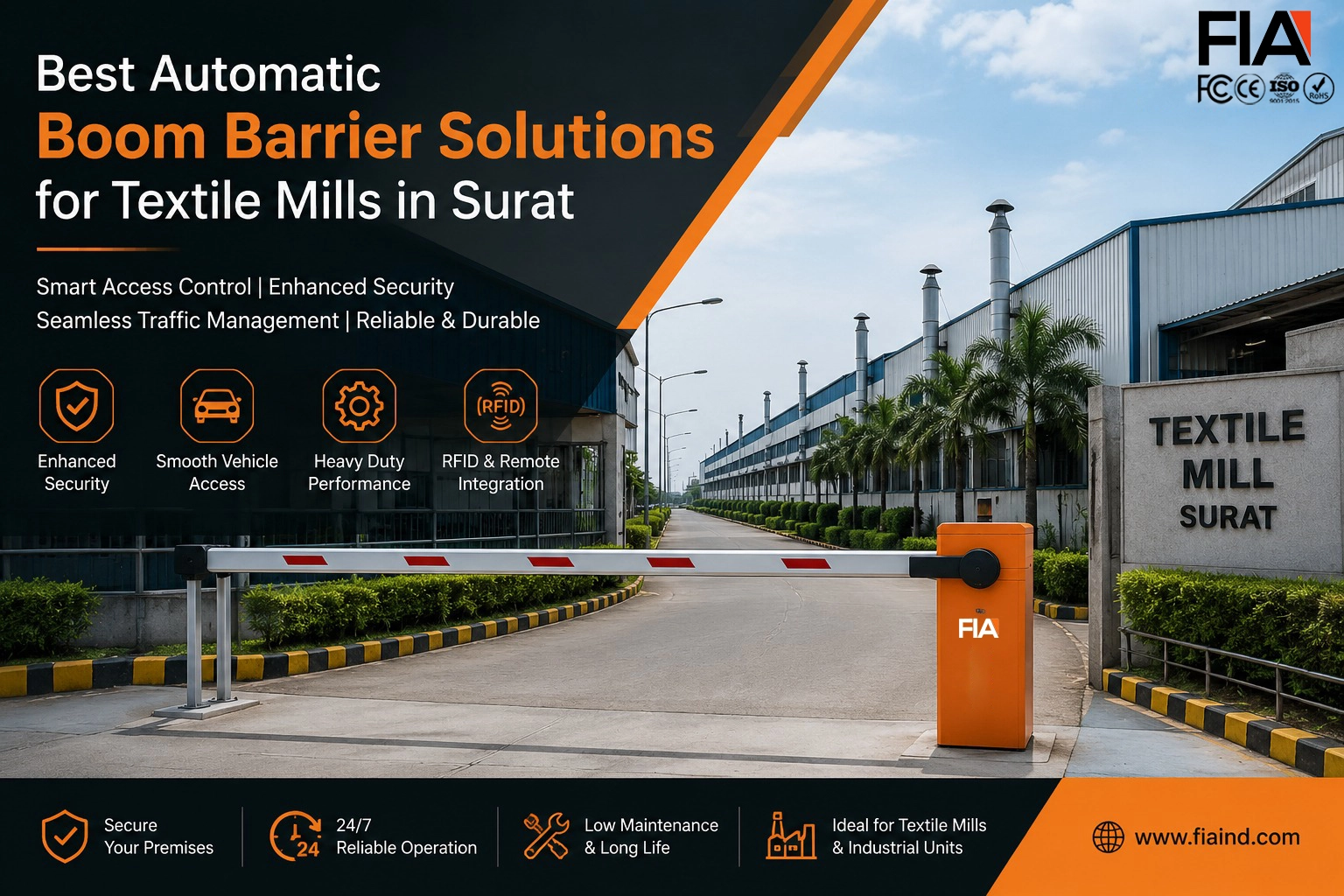
Surat’s textile industry runs on speed. Fabric moves in and out of mills around the clock, trucks queue at gates during shift changes, and raw material deliveries rarely wait for anyone. In an environment like this, the gate is not a small detail — it’s a choke point that can either keep operations flowing or bring them to a standstill. That’s why more textile mill owners across Surat, Sachin, Pandesara, Udhna, and the Ring Road industrial belt are replacing manual gates and boom barriers with automatic boom barriers built for high-frequency, high-load industrial use.
This guide breaks down what actually matters when choosing a boom barrier for a textile mill, which types work best for different mill layouts, and what realistic pricing looks like in the Surat market today.
Why Textile Mills Need a Different Kind of Boom Barrier
A boom barrier at a textile mill isn’t doing the same job as one at a residential society or a small office. Mills typically deal with:
- High vehicle frequency — yarn trucks, dyeing tankers, loom spare parts vehicles, and staff two-wheelers moving in and out constantly during shift changes.
- Heavy and wide vehicles — trailers carrying grey fabric rolls or cotton bales need barriers with longer boom arms and stronger motors.
- Dust and lint exposure — cotton dust and fabric lint can clog standard barrier mechanisms not designed for textile environments.
- Round-the-clock operation — most process houses and mills run three shifts, so the barrier motor needs a high duty cycle rating, not a light-use consumer-grade one.
- Security and compliance needs — with rising theft of yarn, dyes, and finished fabric, mills need access logs, not just a gate that opens and closes.
A barrier that works fine for a housing society will usually fail within months in this kind of environment. This is the core reason mill owners in Surat need boom barriers engineered specifically for industrial-textile duty cycles.
Types of Automatic Boom Barriers Suited for Textile Mills
1. Straight Arm Boom Barriers
The most common choice for mill entry and exit gates because they cover wide spans — useful where trailers and container trucks need to pass. Straight arm barriers with a boom length of 4 to 6 meters are typical for mill compounds with two-lane entry points.
2. Folding Arm Boom Barriers
Ideal where overhead space is limited, such as gates near covered sheds, godowns, or narrow lanes inside older mill premises in areas like Ved Road or Katargam. The arm folds upward instead of extending straight, which keeps clearance requirements lower.
3. RFID Boom Barriers
This is where most textile mills are upgrading right now. An RFID boom barrier in Surat setup allows the mill to issue RFID tags to regular vehicles — raw material suppliers, transport contractors, and staff vehicles — so the barrier opens automatically on tag recognition without a security guard manually operating it every time. This cuts down entry time significantly during peak shift changes and creates a digital log of every vehicle movement, which is valuable for both security audits and insurance documentation.
4. Boom Barriers with ANPR (Automatic Number Plate Recognition)
For larger mills and process houses with multiple gates, combining the barrier with a camera-based ANPR system means even non-tagged vehicles are logged automatically by number plate, which is useful for visitor and vendor tracking.
5. Hydraulic Boom Barriers
Recommended for mills with heavy container or trailer movement, since hydraulic mechanisms handle longer, heavier booms with smoother lowering and reduced wear over high daily cycle counts, compared to standard spring-assisted models.
What Makes a Boom Barrier “the Best” for a Textile Mill
When mill owners ask us what the best boom barrier in Surat actually looks like for their specific site, we generally evaluate five things before recommending anything:
- Duty Cycle Rating — Look for barriers rated for continuous or heavy-duty operation (ideally 100% duty cycle motors), not light-duty residential models, since mill gates open dozens to hundreds of times a day.
- Boom Arm Length and Material — Aluminum booms with reflective strips are standard; mills with wide gates need reinforced or telescopic arms to avoid sagging over time.
- IP Rating for Dust and Moisture — Since textile units generate airborne lint and mills near the Tapi belt deal with humidity, the control panel and motor housing should carry at least an IP54 or higher rating.
- Battery Backup — Surat’s industrial areas do experience power fluctuations; a barrier with a built-in battery backup ensures the gate doesn’t get stuck open or shut during an outage, which matters for both security and safety.
- Integration Capability — The ability to connect with RFID readers, ANPR cameras, or an existing security software system rather than functioning as a standalone mechanical unit.
A barrier that ticks these boxes will typically outperform a cheaper, generic model over its operating life, even if the upfront cost is somewhat higher.
Boom Barrier Price in Surat: What to Realistically Expect
Boom barrier price in Surat varies significantly depending on type, boom length, brand, and whether RFID or ANPR integration is included. As a general guide based on current industrial installations in the region:
- Basic straight arm boom barrier (manual/semi-automatic, up to 3m boom): Entry-level range, suited for small units with low vehicle traffic.
- Automatic straight arm barrier (4-6m boom, standard motor): Mid-range pricing, the most commonly installed option for medium-sized mills.
- Heavy-duty automatic barrier with hydraulic mechanism: Higher price band, justified for mills with frequent trailer and container movement.
- RFID-integrated automatic boom barrier system (barrier + tags + reader): Priced above the standard automatic barrier due to the added hardware and software, but pays back quickly in reduced manual checking time and better security logs.
- ANPR camera-integrated systems: The highest price band among the options above, typically chosen by larger process houses and mills with multiple entry points needing centralized monitoring.
Rather than comparing on price alone, mill owners get better long-term value by comparing the total cost of ownership — installation, annual maintenance, spare part availability, and expected motor lifespan — since a slightly costlier barrier with a strong duty-cycle rating will usually need far less servicing over a 5-year period than a budget unit run at industrial-level frequency.
Installation and Maintenance Considerations Specific to Surat Mills
- Site survey before installation. Gate width, vehicle turning radius, and overhead clearance should be measured on-site rather than assumed, especially in older mill compounds where gate structures were not originally designed with automation in mind.
- Lint and dust cleaning schedule. Mills should build barrier motor housing cleaning into their regular preventive maintenance schedule, not treat it as a one-time installation concern.
- Local service support matters. Given the round-the-clock nature of mill operations, a vendor with a local Surat-based service team who can respond within hours — not days — is far more valuable than a slightly cheaper supplier based out of state.
- Staff training. Security staff need a short training session on manual override procedures in case of a power failure or motor fault, so gate operations don’t stall during an emergency.
Frequently Asked Questions
Q: What is the best type of boom barrier for a textile mill in Surat? For most mills, a heavy-duty automatic straight arm boom barrier with RFID integration offers the best balance of speed, security, and durability, particularly for gates handling frequent truck and staff vehicle movement.
Q: How much does an automatic boom barrier cost in Surat? Pricing depends on boom length, motor duty cycle, and whether RFID or ANPR features are added, ranging from basic mid-range units to higher-end systems with full vehicle-tracking integration.
Q: Is RFID boom barrier installation worth it for a mid-sized mill? Yes, for mills with a regular pool of known vehicles (staff, transport contractors, regular suppliers), an RFID boom barrier significantly reduces manual checking time at the gate and creates an automatic movement log useful for security and compliance.
Q: How long does an automatic boom barrier last in an industrial environment? With proper duty-cycle-rated equipment and regular preventive maintenance, industrial boom barriers typically serve 5 to 8 years or more before major component replacement is needed.
Q: Can an existing manual boom barrier be upgraded to automatic or RFID? In many cases, yes — depending on the existing gate structure and boom arm condition, an upgrade is often more cost-effective than a full replacement, though a site inspection is needed to confirm compatibility.
Final Thoughts
Choosing the right automatic boom barrier for a textile mill in Surat isn’t just about picking whichever unit is available fastest or cheapest. It’s about matching the barrier’s duty cycle, build quality, and integration options to how the mill actually operates — shift patterns, vehicle types, dust exposure, and security needs all play a role. Mills that invest in the right system upfront generally see fewer breakdowns, faster gate movement during peak hours, and better security records over time, making it a decision worth getting right the first time.
For a site-specific recommendation and quotation, connect with the FIA team for a gate assessment tailored to your mill’s layout and traffic pattern.