
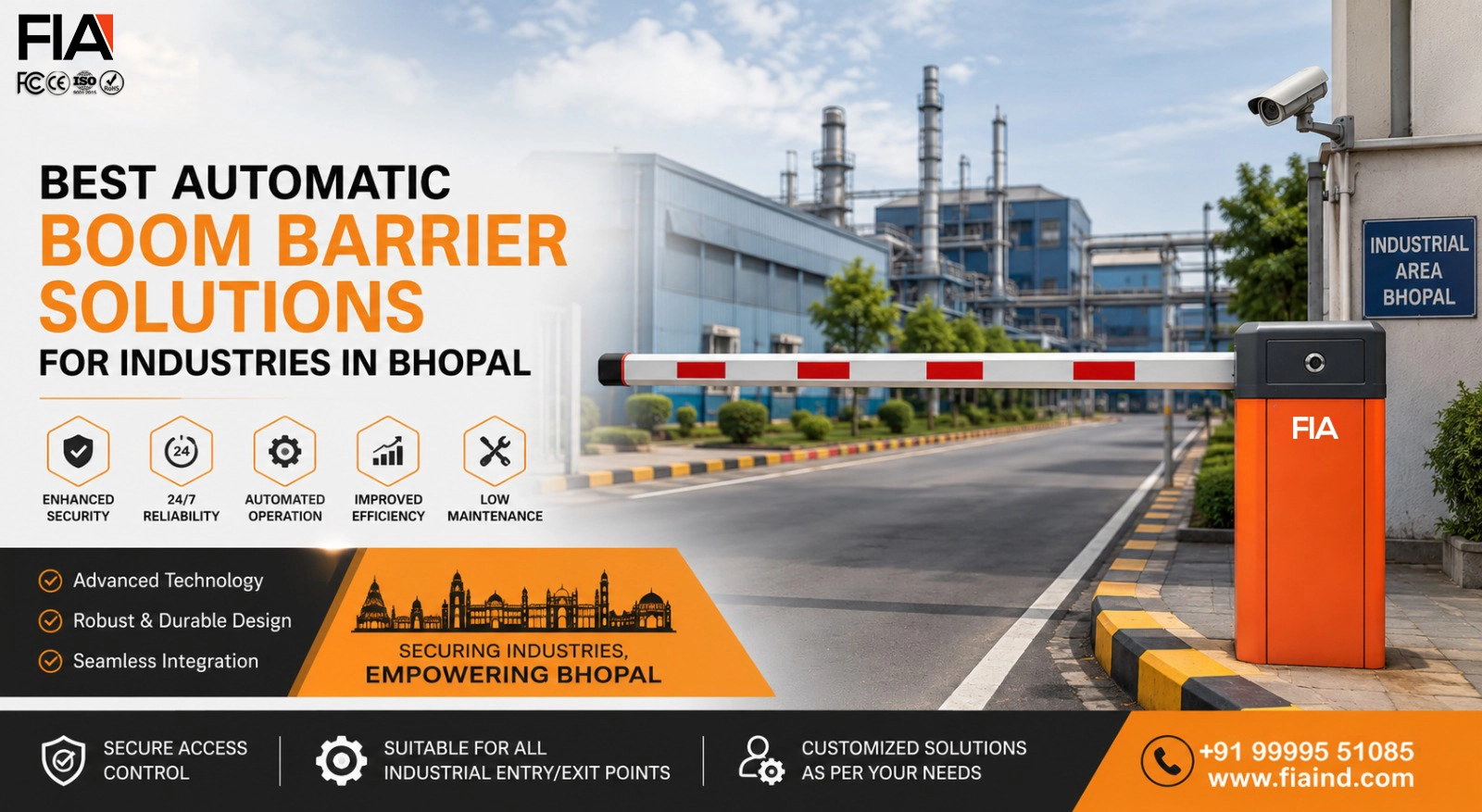
Industrial areas in Bhopal — from Mandideep and Govindpura to the BHEL industrial belt and Pilkhuwa Road — are seeing a Bhopal’s industrial belt — Mandideep, Govindpura, the BHEL cluster, and the logistics parks along Pilkhuwa Road — is handling a level of daily vehicle traffic that most gate infrastructure wasn’t originally designed for. Shift changes bring 50-100 vehicles through a single gate in under 30 minutes. Warehouses are running two or three vendor deliveries an hour. And most facility managers are still relying on either a manual boom or a barrier bought years ago without much thought given to actual traffic load.
This piece isn’t a general explainer. It’s a working analysis of how to evaluate an automatic boom barrier in Bhopal for industrial use — where the real trade-offs sit, why two barriers that look identical on a spec sheet can perform very differently on-site, and how boom barrier price in Bhopal actually breaks down once you separate equipment cost from installed cost.
Duty Cycle Is the Single Most Misunderstood Spec
Every boom barrier is rated by a duty cycle — the number of open-close operations it’s built to sustain per hour without overheating the motor or straining the gearbox. This number is where most industrial buyers get misled, because suppliers often quote a barrier’s maximum theoretical cycle rating rather than its sustained continuous rating.
Here’s the practical distinction:
- A barrier rated for “1,000 cycles/day” might handle that fine if the cycles are spread across 10 hours. It will not handle the same 1,000 cycles compressed into a 45-minute shift-change window — the motor doesn’t get the cooldown time it’s rated for.
- Facilities with clustered traffic (shift changes, single-window vendor gate access) need a barrier rated for intensive duty, typically hydraulic, not the standard electro-mechanical units sold for residential or light-commercial gates.
- Ask suppliers for the duty cycle rating per hour, not per day. This single question filters out roughly half the units marketed as “industrial-grade” that are actually re-badged commercial barriers.
If your facility has genuinely continuous, spread-out traffic (a warehouse with steady single-vehicle entries throughout the day), an electro-mechanical barrier with a lower per-hour rating can be perfectly adequate and considerably cheaper to run. The mistake is applying one barrier type across every gate on a site without mapping traffic patterns gate-by-gate first.
Why Arm Length and Mounting Position Change the Failure Mode
A boom barrier’s arm is usually the first component to fail on an industrial site — not from wear, but from impact. Longer arms (6-8 meters, common on wide factory gates with two-lane entry) experience more torque stress at the pivot point and more wind load during Bhopal’s pre-monsoon gusts.
Two design choices meaningfully reduce failure rates on wide industrial gates:
- Support arm/skid arm addition — a secondary support post under a long boom arm reduces sag and pivot stress, extending gearbox life. This is frequently left out of budget quotes to keep the headline price lower, then sold separately as an “optional accessory” later.
- Break-away or spring-loaded arm joints — if a vehicle misjudges clearance and clips the arm (a common occurrence at busy factory gates with trucks and staff two-wheelers sharing the same lane), a break-away joint prevents the impact from transferring directly to the gearbox, which is the single most expensive component to replace.
If your gate is under 4 meters wide and single-lane, this is largely a non-issue. If it’s wider, these two details matter more to lifetime cost than almost anything else in the spec sheet.
The Integration Layer Determines Whether You’re Buying a Barrier or a System
Most industrial RFPs treat the boom barrier as the product and RFID/ANPR/access control as an afterthought “add-on.” In practice, the barrier is the least differentiated part of the purchase — the control logic around it is where real operational value shows up.
A few integration patterns that matter specifically for industrial (not residential or mall) use:
- Loop detector placement: An induction loop under the road surface prevents the barrier from closing on a vehicle still under it — critical for trucks that are longer than a car and take more time to clear the gate. Loop detectors are frequently omitted from base quotes for cost, which creates a genuine safety gap for facilities with heavy vehicle traffic.
- ANPR vs. RFID for vendor vehicles: RFID tags require distributing and managing a physical tag per vehicle, which becomes an administrative burden for facilities with rotating third-party logistics partners. ANPR (number-plate recognition) avoids the tag-management overhead but needs decent camera lighting and a clean, unobstructed plate-reading zone — harder to guarantee at night or during Bhopal’s monsoon when plates get mud-splashed.
- Barrier-to-visitor-log integration: For facilities under safety or compliance audits, the ability to export a timestamped entry/exit log (not just “barrier opened,” but which vehicle, which credential) is what auditors actually ask for. This depends on whether the barrier’s controller has an open API or proprietary closed logging — worth confirming before purchase, since retrofitting this later is expensive.
The practical implication: two barriers priced identically can deliver very different long-term value depending on whether the controller architecture supports the integrations your compliance or security process will eventually need.
Reframing Boom Barrier Price in Bhopal as a Cost Structure, Not a Number
Boom barrier price in Bhopal is often discussed as if it were a single figure, but for an industrial buyer it’s really four separate cost layers, each with a different sensitivity:
| Cost Layer | What Drives It | Where Buyers Get Misled |
|---|---|---|
| Base unit cost | Duty cycle rating, brand, motor type (hydraulic vs. electro-mechanical) | Comparing electro-mechanical quotes against hydraulic requirements |
| Civil + installation | Foundation work, cabling distance from power source, arm length | Quoted separately, often underestimated for retrofits on existing gates |
| Integration hardware | Loop detectors, RFID/ANPR, LED boom lighting, backup battery | Frequently excluded from the “barrier price” and added later |
| Maintenance (AMC) | Response time SLA, spare parts stocking, whether service is local to Bhopal or routed through a regional call center | Often skipped in year-one budgeting, then becomes the largest recurring cost |
The single highest-leverage question to ask a supplier isn’t “what’s your price” — it’s “what’s excluded from this price.” Civil work and integration hardware routinely add 25-40% on top of the base unit cost for industrial installations, and this is rarely visible in an initial quote unless specifically requested.
On maintenance: a barrier with a 4-hour on-site response SLA from a Bhopal-based technician is worth more than one with a lower AMC fee but a 48-hour response time routed through a national helpline — a stuck barrier at a factory’s main gate isn’t a minor inconvenience, it’s a full operational stoppage.
A Site-Specific Evaluation Framework
Rather than a generic checklist, here’s how to actually map your facility’s requirement before requesting quotes:
- Log your gate’s actual traffic pattern for one week — peak-hour vehicle count, vehicle type mix (cars, trucks, two-wheelers), and whether traffic clusters at shift-change times or spreads evenly.
- Measure gate width and available power supply distance — this determines arm length and cabling cost before you even talk to a supplier.
- Decide your compliance requirement — do you need an exportable, timestamped entry log for insurance or ISO audits, or is barrier automation purely for traffic control? This changes whether ANPR/RFID integration is a necessity or a nice-to-have.
- Request duty cycle per hour, not per day, in every quote — and cross-check it against your logged peak-hour traffic from step 1.
- Ask what’s excluded from the quoted price — civil work, loop detectors, backup power, and AMC terms specifically.
This sequence — traffic data before spec sheet, spec sheet before price comparison — is what separates facilities that get five years of reliable service from a barrier versus those that replace a “cheap” unit within 18 months because it was never rated for their actual gate.
Final Thoughts
The best boom barrier in Bhopal for an industrial site isn’t a fixed product recommendation — it’s the outcome of matching duty cycle, arm engineering, and integration architecture to your facility’s actual traffic pattern and compliance needs. Price comparisons that skip this step tend to compare the wrong things: a light-duty unit against a heavy-duty requirement, or a bare barrier against a fully integrated access-control system.
If you’re evaluating an upgrade, start with a week of traffic logging at your busiest gate before requesting quotes. That single data point will do more to identify the right barrier than any spec sheet comparison.