
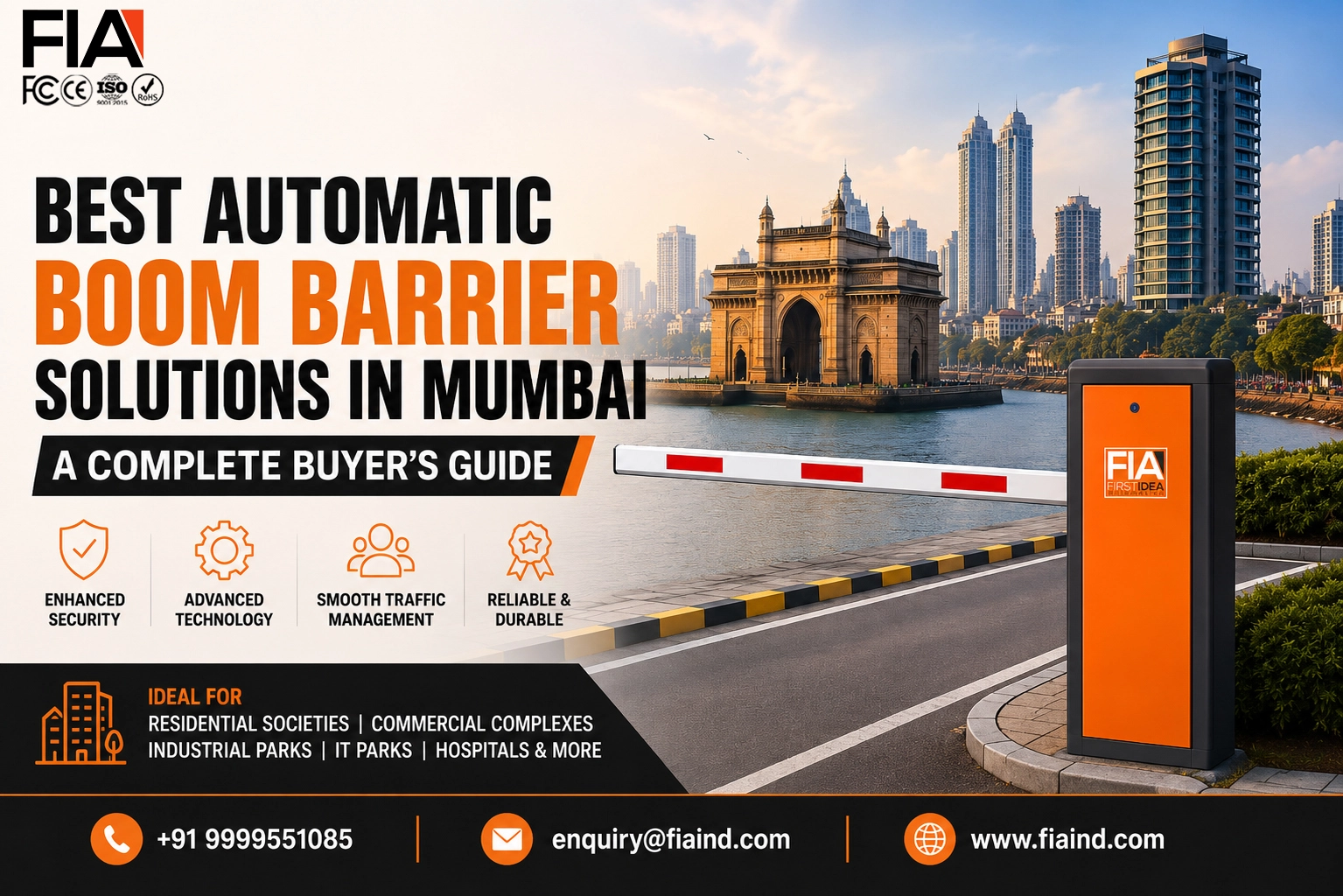
Mumbai’s traffic density, coastal humidity, and round-the-clock commercial activity make it one of the toughest cities in India to deploy access control equipment. A boom barrier that performs flawlessly in a dry Pune industrial park can fail within months at a Mumbai residential society facing salt-laden sea breeze, monsoon flooding, and 500+ vehicle movements a day. This guide breaks down what actually separates the best boom barrier in Mumbai from a mediocre installation, how boom barrier price in Mumbai is structured, and what facility managers, builders, and society committees should evaluate before signing a purchase order.
Why Mumbai Is a Different Ballgame for Boom Barrier Installation
Three environmental and operational factors define Mumbai’s access control landscape:
1. Monsoon exposure (June–September). Sustained rainfall, waterlogging in low-lying areas like Andheri, Kurla, and Sion, and high ambient humidity accelerate corrosion in low-grade barrier arms and control cabinets. IP-rated enclosures are not optional here — they’re a baseline requirement.
2. Coastal salinity. Areas within a few kilometers of the coastline (Worli, Bandra, Colaba, Navi Mumbai’s creek-side belts) see faster metal fatigue. Barrier housings without marine-grade or powder-coated finishes visibly rust within 12–18 months.
3. High-frequency cycling. Commercial complexes in BKC, Lower Parel, and Andheri MIDC, along with residential societies with 200+ units, can see barrier cycles well above 1,000 openings per day. This is far above the duty cycle many entry-level barriers are rated for, which is why motor quality and duty-cycle rating matter more in Mumbai than in low-footfall towns.
What Defines the Best Boom Barrier in Mumbai
Not every barrier marketed as “heavy-duty” actually holds up to Mumbai conditions. Based on real deployment patterns across residential, commercial, and industrial sites in the Mumbai Metropolitan Region (MMR), the following criteria consistently separate reliable systems from ones that generate recurring service calls.
1. Duty Cycle Rating Matched to Actual Footfall
A barrier rated for intermittent use (typically under 100 cycles/day) will burn out prematurely at a busy commercial gate. For high-traffic sites — malls, IT parks, toll-style entries — look for barriers rated for continuous or heavy-duty cycling, generally 60% duty cycle or higher, with brushless DC or servo motor options for minimal maintenance.
2. Boom Length and Site Geometry
Mumbai’s road width constraints mean gate entries are often narrower or more angled than standard layouts. Straight arm barriers work for wide, single-lane entries, while folding-arm (articulated) barriers are increasingly preferred in space-constrained residential compounds and narrow commercial driveways where a full-length straight arm isn’t practical.
3. Corrosion-Resistant Build
For coastal and monsoon-heavy zones, prioritize barriers with galvanized steel or aluminum housings, UV-stabilized powder coating, and IP54/IP55-rated control boxes at minimum. This single specification difference is often the reason one installation lasts 7–8 years while another needs cabinet replacement within 2 years.
4. Battery Backup and Power Reliability
Mumbai experiences localized power fluctuations, especially during heavy rains. A boom barrier without integrated battery backup becomes a bottleneck during outages — either stuck open (a security risk) or stuck closed (a traffic pileup). Battery backup with 8–12 hours of standby is now considered standard for serious installations, not a premium add-on.
5. Integration Capability
The best boom barrier in Mumbai today isn’t a standalone mechanical device — it integrates with:
- RFID/FASTag-based vehicle recognition for societies and corporate parks
- ANPR (Automatic Number Plate Recognition) cameras for visitor logging
- Loop detectors and photocell safety sensors to prevent vehicle strikes
- Centralized software for multi-gate societies or business parks with several entry points
Sites that skip integration often end up retrofitting within 2–3 years as security requirements tighten, which costs more cumulatively than installing an integration-ready system upfront.
6. After-Sales Service Network
This is the most underrated factor. A barrier with excellent specs but no local Mumbai-based service technician means every fault — even a minor sensor misalignment — turns into a multi-day downtime. Facility managers should confirm the vendor has a functioning service team covering the specific ward or suburb (South Mumbai, Western Suburbs, Eastern Suburbs, Thane, Navi Mumbai, and MMR extensions like Panvel and Kalyan) before purchase, not after.
Boom Barrier Price in Mumbai: What Actually Drives the Cost
Boom barrier price in Mumbai varies widely because it’s not a single-SKU purchase — it’s a system built around your site’s specific requirements. Rather than quoting a flat number that will inevitably become outdated, here’s what actually moves the price:
Barrier arm length and type. Standard 3–4 meter straight arms cost less than long-span or folding-arm variants designed for wide MMR commercial entries.
Motor and duty cycle class. Light-duty motors for low-traffic residential gates are the most economical. Heavy-duty and industrial-grade continuous-cycle motors, needed for commercial and high-rise society entries, sit at the higher end.
Material and IP rating. Marine-grade, corrosion-resistant housings with higher IP ratings (suited to coastal Mumbai and monsoon exposure) cost more than standard indoor-rated cabinets, but reduce long-term maintenance spend significantly — an important factor when comparing total cost of ownership, not just upfront price.
Accessories and integration. RFID readers, ANPR cameras, loop detectors, UPS/battery backup units, and remote/app-based control each add incrementally to the base barrier cost. A fully integrated smart gate system will always cost more than a barrier-only unit, but for high-security or high-traffic Mumbai sites, this is usually the better long-term investment.
Installation complexity. Sites requiring civil work, cable trenching, or custom foundation mounting (common in older Mumbai buildings and narrow lanes) add to installation cost beyond the equipment price itself.
AMC (Annual Maintenance Contract). Mumbai’s humidity and traffic volume make an AMC almost essential rather than optional. Factor this recurring cost into your total budget from the start rather than treating it as an afterthought.
The practical takeaway: request a site-specific quotation rather than relying on a generic listed price, since Mumbai’s environmental and traffic variables genuinely change what specification you need.
Choosing the Right Boom Barrier by Location Type in Mumbai
Residential societies (Andheri, Malad, Mulund, Thane, Navi Mumbai): Prioritize compact folding-arm barriers with RFID-based resident recognition and visitor management integration, given space constraints and the need for organized entry logging.
Commercial complexes and IT parks (BKC, Lower Parel, Powai, Airoli): Heavy-duty, high-cycle barriers with ANPR integration and centralized management software are the standard, given continuous vehicle flow across working hours.
Industrial and logistics zones (MIDC belts, Bhiwandi, Taloja): Robust, weatherproof barriers built for outdoor exposure and high-frequency heavy-vehicle movement, often paired with weighbridge or dock-entry systems.
Hospitals and institutional campuses: Reliability and battery backup take priority, since barrier downtime directly affects emergency vehicle access.
Common Mistakes to Avoid When Buying a Boom Barrier in Mumbai
- Choosing purely on lowest price — a cheaper barrier with a lower duty-cycle rating for a high-traffic site leads to frequent breakdowns and higher lifetime cost.
- Ignoring IP rating — a standard-rated cabinet in a coastal or flood-prone location is a guaranteed early failure.
- Skipping safety sensors — photocell and loop detector safety features aren’t optional extras; they prevent vehicle and pedestrian accidents at the gate.
- No AMC plan — Mumbai’s climate demands scheduled maintenance; reactive-only service leads to longer downtime.
- Overlooking vendor service coverage — always confirm local technician availability in your specific Mumbai suburb before finalizing.
Frequently Asked Questions
Which is the best boom barrier for high-traffic entry points in Mumbai? For high-cycle commercial and residential entries, heavy-duty barriers with brushless motors, IP54/IP55-rated enclosures, and integrated safety sensors consistently perform best under Mumbai’s traffic and humidity conditions.
What affects boom barrier price in Mumbai the most? Motor duty-cycle class, arm length/type, corrosion-resistant housing grade, and integrated accessories (RFID, ANPR, battery backup) are the primary cost drivers, followed by installation complexity and AMC terms.
Do boom barriers need special specifications for coastal Mumbai locations? Yes. Sites near the coastline should use marine-grade or powder-coated corrosion-resistant housings and higher IP-rated control boxes to withstand salinity and monsoon exposure.
Is an AMC necessary for boom barriers installed in Mumbai? Given the city’s humidity, monsoon intensity, and high traffic cycles, an Annual Maintenance Contract is strongly recommended to avoid unplanned downtime and extend equipment lifespan.
Final Thoughts
Selecting the best boom barrier in Mumbai isn’t about picking the most expensive or most feature-loaded model — it’s about matching duty cycle, build quality, and integration needs to your site’s actual traffic pattern and environmental exposure. Whether you’re securing a residential society in the suburbs, a commercial tower in BKC, or an industrial facility in the MIDC belt, getting the specification right the first time saves significantly more than any upfront discount on boom barrier price in Mumbai.
For a site-specific assessment and quotation tailored to your location, traffic volume, and integration requirements, connect with FIA’s Mumbai team for a consultation.