
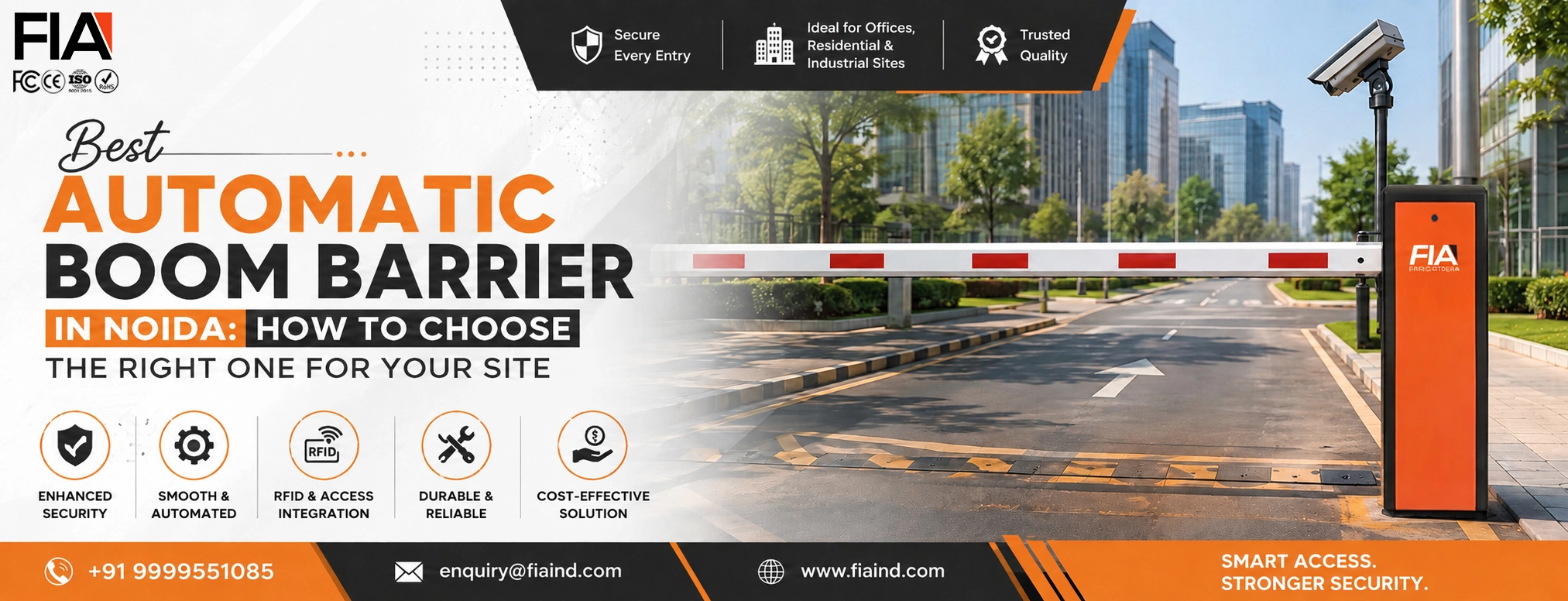
Vehicle access control has become a near-default requirement across Noida’s commercial and residential landscape — from IT parks in Sector 62 and Sector 132, to warehousing and logistics hubs in Ecotech and Site V, to gated societies across Greater Noida West and Noida Extension. The automatic boom barrier is usually the first piece of hardware installed at any vehicle entry point, and it’s also one of the most misjudged purchases, because buyers often compare barriers on price and arm length alone without accounting for how the unit will actually perform under daily traffic load.
Related guide: Compare plate recognition and tags in FIA’s ANPR vs RFID vehicle access control guide before finalising the gate workflow.
At FIA (First Idea Automation), we’ve supplied and serviced boom barriers across corporate campuses, residential townships, industrial units, and institutional sites throughout Noida and the broader Delhi NCR belt. What follows is a practical breakdown of what actually determines whether a boom barrier holds up under real-world traffic — not just what a spec sheet promises.
Why Getting the Boom Barrier Spec Right Matters
A boom barrier sized for the wrong traffic volume tends to fail in one of two predictable ways: either the motor wears out early from being cycled far more often than it was rated for, or the barrier becomes a bottleneck because its cycle time is too slow for the number of vehicles trying to pass during peak hours. A society gate in Greater Noida West handling a few hundred vehicle movements a day has very different requirements from a logistics park in Site V running barriers continuously across three shifts. Matching the barrier to the actual duty cycle of the site is the single biggest factor in long-term reliability.
Key Factors to Evaluate Before Choosing a Boom Barrier
1. Duty Cycle Rating
Every boom barrier motor is rated for a certain number of operations per hour, expressed as a duty cycle percentage. Light-duty barriers (typically rated for lower-frequency use) suit residential societies and small offices with intermittent traffic. Heavy-duty and industrial-grade barriers, built for continuous or near-continuous operation, are necessary for corporate campuses, toll-style entries, and logistics or warehousing sites where vehicles pass every few seconds during peak windows. Buying a light-duty barrier for a high-frequency site is the most common cause of premature motor failure.
2. Boom Arm Length and Road Width
Boom arms typically range from around 3 metres up to 6 metres or more, with longer arms requiring additional support (such as a support post or articulated joint) to prevent sagging over time. Wider entry roads — common at corporate campuses and industrial gates — need either a longer arm with proper support or a dual-barrier configuration. Getting this wrong leads to either an arm that doesn’t fully cover the lane or one that droops and misaligns within months.
3. Opening and Closing Speed
Cycle speed directly affects traffic flow at busy entry points. For high-footfall corporate and residential gates in sectors like 62, 63, and 137, a barrier with an adjustable, faster opening speed reduces queuing at peak entry and exit times. For lower-traffic sites, a moderate speed is usually sufficient and puts less mechanical strain on the arm and motor over time.
4. Safety Features
A boom barrier controls vehicle movement in areas where pedestrians, two-wheelers, and cars often share the same lane, so safety mechanisms matter as much as speed. Look for auto-reverse or obstacle-detection sensors that stop or reverse the arm if something is detected underneath it, along with photoelectric safety beams where pedestrian crossover is likely. Sites with mixed vehicle and foot traffic — like residential societies and school gates — should treat these features as essential rather than optional add-ons.
5. Build Quality and Weather Resistance
Boom barriers installed in Noida operate through hot, dusty summers and a humid monsoon season, almost always in fully exposed, outdoor conditions. A barrier housing with proper IP-rated weatherproofing, corrosion-resistant coating, and a motor designed to handle temperature and humidity swings will hold up significantly longer than a unit built primarily for indoor or covered use. This is one of the most overlooked specifications, since it rarely shows up as a problem until the following monsoon season.
6. Power Backup and Manual Override
Given occasional power fluctuations across parts of Noida and Greater Noida, a boom barrier with battery backup ensures the gate remains operational during short outages instead of getting stuck in either an open or closed position. Equally important is a reliable manual release mechanism, so security staff can raise or lower the arm by hand during extended outages or maintenance without needing to force the motor housing.
7. Integration with Access Control Systems
Most modern boom barrier installations in Noida aren’t standalone — they’re tied into RFID/tag-based vehicle access, ANPR (automatic number plate recognition) cameras, or a broader access-control and visitor-management system. Before finalizing a barrier, confirm it supports integration with whatever access-control setup your site uses or plans to adopt, since retrofitting integration onto an incompatible barrier later is far more expensive than specifying it correctly the first time.
8. Local Installation and Service Support
A boom barrier is a mechanical system with moving parts that require periodic lubrication, spring or hydraulic adjustment, and occasional part replacement. Buying from a vendor without a genuine service presence in Noida or NCR often means long wait times for a technician when the arm jams or the motor starts underperforming — and a stuck barrier at a busy entrance is a security and traffic problem, not just an inconvenience. FIA maintains a local NCR-based service team specifically so that boom barrier faults across Noida and Greater Noida sites are addressed quickly rather than routed through a distant regional office.
Where Automatic Boom Barriers Are Commonly Installed Across Noida
- Corporate and IT campuses — Sector 62, Sector 63, and Sector 132 house large office parks where vehicle entry needs to be fast, controlled, and integrated with employee access systems.
- Industrial and logistics hubs — Ecotech and Site V see continuous vehicle movement across shifts, requiring heavy-duty, high-cycle barriers.
- Residential townships — Greater Noida West, Noida Extension, and sectors like 78, 79, and 93 use boom barriers as a core part of gated-community vehicle access control.
- Educational institutions — Campuses in Sector 50 and Knowledge Park (Greater Noida) use boom barriers alongside pedestrian screening for controlled vehicle drop-off and pick-up.
- Government and institutional buildings — Facilities around the Sector 6 administrative belt typically require barriers that meet specific procurement and safety standards.
Common Mistakes to Avoid
- Choosing arm length without accounting for road width, resulting in sagging or incomplete lane coverage.
- Selecting a light-duty barrier for a high-frequency gate, leading to early motor failure.
- Skipping safety sensors on sites with mixed pedestrian and vehicle traffic.
- Overlooking integration requirements with existing or planned access-control systems.
- Buying from a vendor with no local service history in Noida or the wider NCR region, leading to long repair turnaround times.
How FIA Approaches Boom Barrier Selection in Noida
Every FIA boom barrier deployment starts with a site assessment — measuring actual traffic volume and peak-hour load, road width, power availability, and whether the barrier needs to integrate with an existing RFID, ANPR, or visitor-management system. Based on that survey, we recommend a duty-cycle and arm configuration suited to the site rather than defaulting to a single standard model, and back the installation with a local NCR service team and documented AMC options for ongoing maintenance.
Frequently Asked Questions
What is the best boom barrier for a residential society in Noida? For most residential gates, a light-to-medium duty barrier with a 3–4 metre arm, RFID tag integration, and auto-reverse safety sensors is generally sufficient, since traffic volume is typically lower and intermittent compared to commercial sites.
What type of boom barrier suits a high-traffic corporate campus? Corporate campuses with continuous vehicle flow during peak hours generally need a heavy-duty barrier with a fast, adjustable cycle speed and integration with employee access or ANPR systems to avoid queuing at entry points.
How often should a boom barrier be serviced? Most manufacturers recommend a maintenance check every three to six months, with more frequent servicing for high-cycle sites such as logistics parks and busy corporate entrances.
Can a boom barrier work reliably during power cuts in Noida? Yes, provided the unit has battery backup and a functional manual release mechanism, allowing security staff to operate the barrier manually until power is restored.
Final Thoughts
The right automatic boom barrier for a Noida installation depends on matching duty cycle, arm length, safety features, and integration needs to the site’s actual traffic pattern — not on choosing the cheapest unit with the longest arm on paper. A correctly specified barrier, backed by a vendor with genuine local service capability, delivers years of reliable operation with minimal downtime.
For a site assessment, product recommendation, or AMC quote for boom barrier installation across Noida, Greater Noida, and Delhi NCR, get in touch with the FIA (First Idea Automation) team today.