
Introduction
Choosing a vehicle access system is less about finding one “best” technology and more about matching the identification method to site operations. A housing society with permanent residents has a different gate workflow from a hospital, office campus or factory with frequent visitors.
ANPR and RFID can both work with an automatic boom barrier, but they identify vehicles differently. This guide explains the trade-offs and questions to answer before selecting either system or combining both.
Understanding the Technologies: ANPR vs RFID
How ANPR vehicle access works
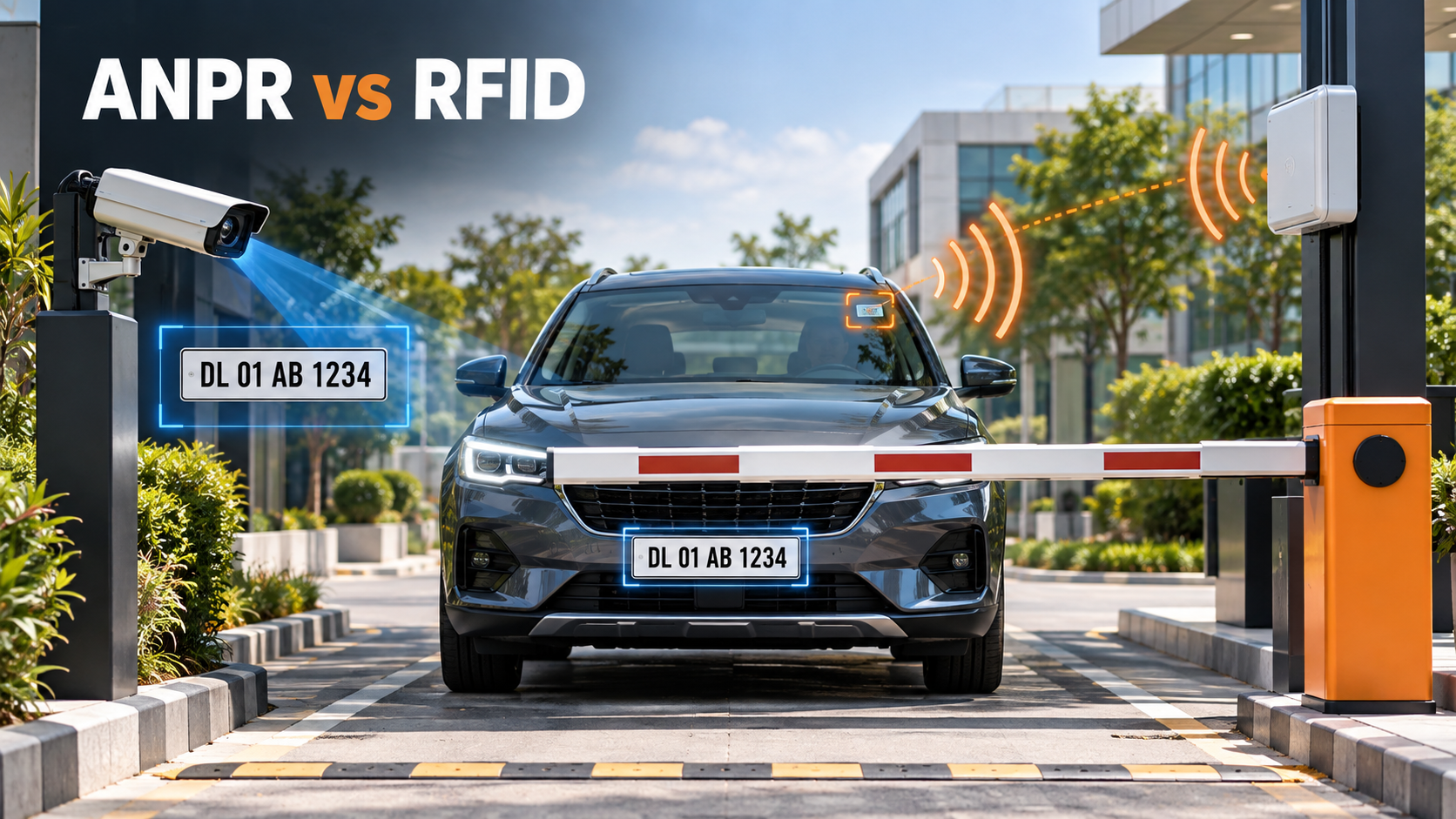
Automatic Number Plate Recognition, or ANPR, uses a camera and software to read a vehicle’s registration plate. The system compares the captured plate number with an authorised list or a visitor record. When the configured access rule is satisfied, the controller can signal the boom barrier to open.
ANPR does not require a tag to be attached to every vehicle. That can make it useful for locations with visitors, contractors, deliveries or vehicles that change regularly. A plate can be registered before arrival, subject to the site’s visitor approval process.
Camera position, lighting, plate condition, traffic direction and the site layout can affect recognition performance. These points should be checked during a site survey. Any promised accuracy level or response time should be supported by the proposed equipment specification and conditions at that site.
How RFID vehicle access works
RFID access uses a tag assigned to a vehicle and a reader installed near the entry lane. When the reader detects an authorised tag, the access controller can trigger the barrier. UHF tags and long-range readers are commonly considered when the vehicle should be identified before it reaches the barrier arm.
RFID can suit a stable population of known vehicles, such as residents, employees or an approved fleet. The facility team must issue tags, maintain the authorised-tag list and define what happens when a tag is lost, damaged, transferred or no longer permitted.
Reader position, tag placement, vehicle glass and lane geometry should be validated at the site. Read range and response should come from the chosen hardware specification and installation test, rather than a general claim.
Operating Trade-offs and Visitor Handling
Key points
- Compare ANPR cameras and RFID/UHF tags combined with automatic boom barriers.
- Address key factors: site suitability, visitor management, operational trade-offs, and security needs.
- Explain hybrid deployment options combining ANPR and RFID.
- Highlight integration with safety sensors and centralized access-control software across housing societies, offices, factories, campuses, hospitals, and commercial parking facilities in India.
Questions answered in this guide
- What is the difference between ANPR and RFID for vehicle access control?
- Which system is better for handling visitor vehicles vs. regular residents or employees?
- Can ANPR and RFID be deployed together in a hybrid setup?
- Which vehicle access control technology is best suited for my specific facility type in India?
Practical comparison
| Decision factor | ANPR | RFID or UHF tags |
|---|---|---|
| Vehicle identity | Registration plate | Assigned electronic tag |
| Item issued to driver | Usually none | A tag must be issued and managed |
| Permanent users | Can use an approved plate list | Can use an approved tag list |
| Visitors | Plate can be pre-registered through a visitor workflow | Requires another visitor method, a temporary tag or guard action |
| Main site checks | Camera view, lighting, plate visibility and lane approach | Reader position, tag placement, lane approach and tag administration |
| Common administration | Add, remove and review plate records | Issue, replace, revoke and audit tags |
| Suitable control options | Can integrate with barrier and central access software | Can integrate with barrier and central access software |
The table does not make one system universally superior. It shows where the daily operating work differs. A facility should compare the number of permanent vehicles, visitor frequency, security policy, available lanes and the team’s ability to manage physical tags.
Site Suitability and Hybrid Deployment
Which system fits each site type?
Housing societies and gated communities
RFID may be convenient for a known set of resident vehicles. ANPR can support pre-registered guests or vehicles that should be identified by plate. A combined system can keep the resident workflow simple while giving the security desk a controlled visitor process.
Offices and commercial campuses
Employee vehicles form a stable group, while candidates, clients, service teams and deliveries change. Either technology can handle employees. ANPR may reduce the need to issue a physical item to every short-term visitor, provided the visitor process captures and approves the correct plate.
Factories and industrial facilities
Industrial gates may handle employees, company fleets, transporters, vendors and restricted zones. The decision should include lane width, vehicle mix, shift traffic, approval rules and the audit information required by the security team. FIA lists industrial facilities among the applications for its boom barrier systems.
Hospitals and educational institutions
These sites often combine staff parking with visitors and service vehicles. Teams should separate emergency or priority access from routine entry rules and ensure that the barrier design includes an appropriate manual process for exceptional situations.
When a hybrid ANPR and RFID system makes sense
A hybrid lane uses both identification methods within one access-control design. For example, RFID may identify registered employee or resident vehicles, while ANPR supports approved visitors. A higher-security rule may also require the tag assignment and plate record to match before access is granted, if the selected controller and software support that workflow.
Hybrid design adds flexibility, but it also adds components and administration. The site survey should confirm how the controller, camera, reader, safety sensors and barrier communicate; who owns each access list; and what the guard sees when a vehicle is rejected.
FIA states that its automatic boom barriers support integration with RFID readers, UHF long-range tags, ANPR cameras, biometric systems, smart ticketing and centralised entry and exit management. The product page also lists obstacle detection, manual override, wired or wireless controls and barrier lengths from 3 m to 6 m. The final configuration should still be verified against the selected model and approved site design.
Buyer Decision Checklist for Indian Facilities
- How many vehicles are permanent users, and how many are visitors or vendors?
- Must a visitor be approved before arrival, at the gate or by a host?
- Can the team reliably issue, revoke and audit physical tags?
- Are number plates consistently visible on the lane approach?
- What lighting, camera position and network connection are available?
- Which existing visitor, parking or access-control software must connect to the system?
- What should happen during a power, network or identification failure?
- Which safety sensors and manual controls are required for the lane?
- What reporting or entry and exit records does the security team need?
- Who will maintain the hardware, software records and operating procedure?
Ask the supplier to document the proposed lane layout, equipment list, integration scope, assumptions, exclusions, testing method and support responsibilities. This makes quotations easier to compare and reduces ambiguity during installation.
Frequently Asked Questions (FAQs)
Is ANPR better than RFID for visitors?
ANPR can be practical when visitors can submit a plate number before arrival. RFID can still support visitors, but the site needs a process for temporary tags or another entry method. The better choice depends on visitor volume and approval workflow.
Is RFID better for residents or employees?
RFID can suit a stable, authorised vehicle list. Its success depends on disciplined tag assignment, revocation and replacement. ANPR can also serve permanent users when plate records are maintained correctly.
Can ANPR and RFID control the same boom barrier?
Yes, when the selected controller and software support both integrations. FIA lists RFID, UHF tags and ANPR among the integration options for its automatic boom barriers. The exact workflow should be confirmed for the proposed equipment.
What happens if identification fails?
The operating design should define a safe exception process, such as guard verification and an authorised manual control. The method should preserve site security and avoid unsafe vehicle movement.
What should determine the final choice?
Use the site’s vehicle mix, visitor process, lane conditions, security policy, integration needs and maintenance capacity. Validate the design through a site assessment before relying on a performance or commercial estimate.
Conclusion and Next Steps
ANPR reduces dependence on physical tags and can support changing vehicle populations. RFID gives known vehicles a managed electronic identity. A hybrid design can cover both patterns when the added complexity is justified.
FIA provides vehicle access automation options that combine automatic boom barriers with identification, safety and control components. Contact FIA for a site assessment and a configuration based on your lanes, users and security process.