
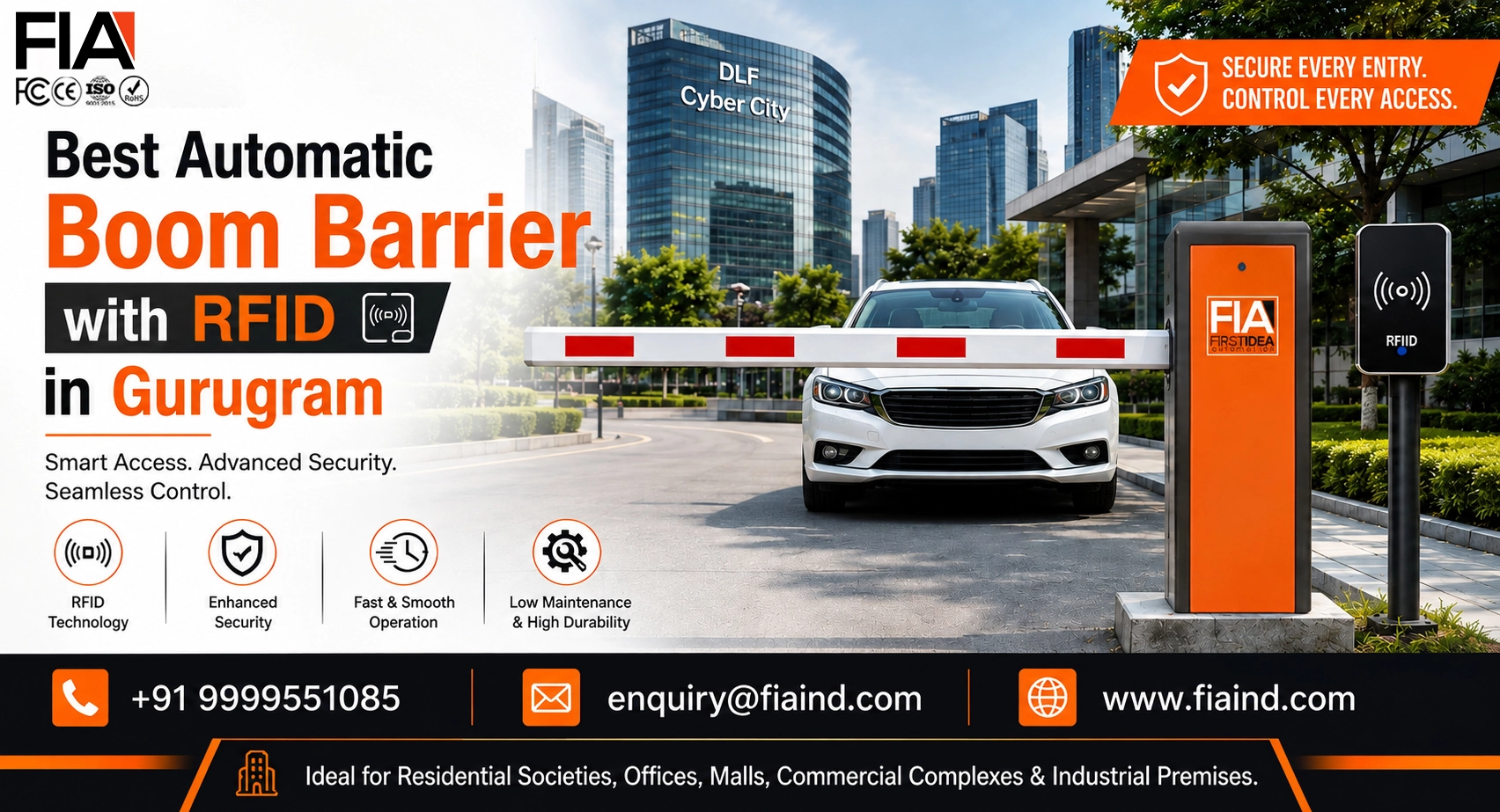
Anyone who has tried to enter Cyber City between 8:30 AM and 10:00 AM on a weekday knows the real problem Gurugram’s security managers are trying to solve. It isn’t “how do we stop a vehicle.” It’s “how do we stop a vehicle without adding forty seconds to every single entry, six days a week, for a workforce of eight thousand people.” That distinction is why the search for the best automatic boom barrier with RFID in Gurgaon has become less about the barrier arm itself and more about the entire access-control system sitting behind it.
This guide is written for facility managers, RWA committees, and procurement teams evaluating vendors in Gurugram — not as a product pitch, but as a framework for asking the right questions before you sign a purchase order.
Why Gurugram Is a Different Deployment Environment
Gurugram isn’t a neutral backdrop for a boom barrier installation. Three local factors change what “best” actually means here:
Traffic density and time-of-day pressure. Corporate hubs like Cyber City, Golf Course Road, MG Road, and Udyog Vihar see extreme entry/exit spikes at shift-change hours. A barrier with a slow cycle time that’s perfectly adequate for a low-footfall gated society becomes a bottleneck outside a Sohna Road IT park.
Mixed-use density. Gurugram has residential high-rises, industrial estates in Manesar and Udyog Vihar, standalone corporate campuses, and retail complexes often within a few kilometers of each other. Each has a different vehicle mix — two-wheelers, delivery fleets, executive cars, visitor traffic — and the “top” system for one is rarely the top system for another.
Heat, dust, and monsoon load. Long summers with high ambient temperatures, dust ingress on arterial roads like NH-48, and a genuinely wet monsoon season put real stress on motor housings, RFID readers, and control boards. A barrier rated for a milder climate zone will show its weaknesses here first — usually within the first two summers.
Any evaluation of the best automatic boom barrier with RFID in Gurugram has to start from these conditions, not from a generic spec sheet.
What “RFID-Enabled” Actually Needs to Mean
RFID tagging is now close to a baseline expectation, but the quality gap between implementations is significant. When comparing vendors, look past the marketing line “RFID enabled” and check these specifics:
- Read range and reliability at speed. A reader that performs well in a demo but struggles to read a windshield tag on a vehicle moving at 15–20 km/h will cause exactly the queuing problem the system was meant to prevent.
- Frequency and tag type. UHF RFID generally outperforms low-frequency systems for vehicle access at typical Indian gate speeds and offers longer read distances, which matters for wider Gurugram driveways.
- Anti-collision handling. In multi-lane entries common at large corporate campuses, the reader needs to correctly distinguish between adjacent vehicles rather than triggering the wrong barrier.
- Integration depth. Does the RFID layer talk to your existing visitor management, ANPR (automatic number plate recognition), or society management software, or does it operate as an isolated silo that a guard still has to reconcile manually?
- Data and access logs. For commercial campuses in particular, audit trails of entry/exit by tag ID are often a compliance requirement, not a convenience feature.
A genuinely top-tier system treats RFID as one layer in a broader access-control stack, not as a standalone gadget bolted onto an old barrier arm.
Core Hardware Criteria for Choosing the Best Boom Barrier
Once the RFID layer checks out, the mechanical and electrical fundamentals still decide long-term reliability:
- Cycle time and duty cycle. Look for barriers rated for high-frequency operation (heavy duty cycle) if you’re deploying at a Gurugram corporate campus or mall with continuous traffic, rather than light-duty barriers meant for occasional residential use.
- Arm length and boom type. Straight arms suit narrow single-lane gates; articulated or folding arms suit wider Gurugram driveways where a full-length straight boom would be unsafe or impractical.
- IP rating. An IP54 or higher rating for the control cabinet is a reasonable minimum given local dust and monsoon exposure.
- Battery backup. Given periodic power fluctuations across NCR, an integrated UPS or battery backup that keeps the barrier operational for a defined window during an outage is a genuine differentiator, not a luxury add-on.
- Safety sensors. Photocell/infrared safety beams that halt the arm if a vehicle or pedestrian is detected mid-cycle are essential at high-footfall Gurugram sites, both for liability reasons and basic safety.
- Local service support. A barrier is only as good as the technician who can reach your site within a few hours of a fault. Vendors with an established Gurugram or NCR service presence generally outperform those shipping support from a distant regional office.
Where This Matters Most Across Gurugram
The “best” system genuinely differs by site type:
- Corporate campuses (Cyber City, Golf Course Road, Udyog Vihar): Prioritize heavy-duty cycle ratings, ANPR + RFID integration, and multi-lane throughput.
- Residential societies (Sohna Road, Sector 47–56 belt, Golf Course Extension Road): Prioritize quiet operation, tamper alerts, resident-tag management via app or software, and a lower total cost of ownership over pure speed.
- Industrial and logistics parks (Manesar, Udyog Vihar): Prioritize ruggedness, dust resistance, and integration with weighbridge or fleet-tracking systems where heavy vehicles are common.
- Retail and mixed-use complexes: Prioritize visitor-tag issuance workflows and short-duration parking integration alongside the RFID layer for regular tenants.
Treating all four categories as one buying decision is one of the most common procurement mistakes in this market.
A Practical Evaluation Checklist
Before shortlisting vendors for an automatic boom barrier with RFID in Gurgaon, it helps to score each option against a consistent set of criteria rather than comparing quotes in isolation:
- Does the RFID reader have a documented read range and accuracy specification, not just a marketing claim?
- Is the barrier’s duty cycle rating matched to your actual daily open/close volume?
- What is the warranty period on the motor and control board specifically, not just the overall unit?
- Can the vendor demonstrate an existing installation in a comparable Gurugram site — similar footfall, similar climate exposure?
- What is the guaranteed service response time, and is there a local NCR service team?
- Does the system support software-based tag management, or does every addition/removal require a technician visit?
- Are safety sensors included as standard, or priced as an optional add-on?
A vendor that can answer all seven clearly, with site references, is a stronger indicator of quality than a lower upfront quote.
Cost Considerations Without the Guesswork
Pricing for automatic boom barriers with RFID in Gurugram varies with duty cycle rating, arm length, RFID reader quality, and whether ANPR is bundled in. Rather than anchoring on a single number, request an itemized quote that separates the barrier mechanism, the RFID/ANPR layer, installation and civil work, annual maintenance contract (AMC) terms, and any software licensing for tag or visitor management. This breakdown is what actually lets you compare “best value” rather than just “lowest price” across vendors.
Compliance and Installation Notes Specific to Gurugram
Gated communities and commercial properties in Gurugram should coordinate barrier placement with RWA or facility management approvals where applicable, and ensure the installation doesn’t obstruct fire-tender access lanes — a requirement that municipal and fire safety authorities in Haryana take seriously during inspections. Positioning safety signage and reflective markers near the barrier is a low-cost step that meaningfully reduces liability risk, particularly at sites with mixed pedestrian and vehicle traffic.
Final Thoughts
The best automatic boom barrier with RFID in Gurgaon isn’t a single named product — it’s the combination of hardware duty cycle, RFID reader quality, local service backing, and integration depth that matches your specific site’s traffic pattern. A Cyber City campus and a Sohna Road residential society are solving different problems, even though the marketing brochures often look identical.
If you’re evaluating vendors, start from the checklist above rather than the spec sheet’s headline claims — it’s the fastest way to separate a genuinely top-performing system from one that will underperform within its first Gurugram summer.