
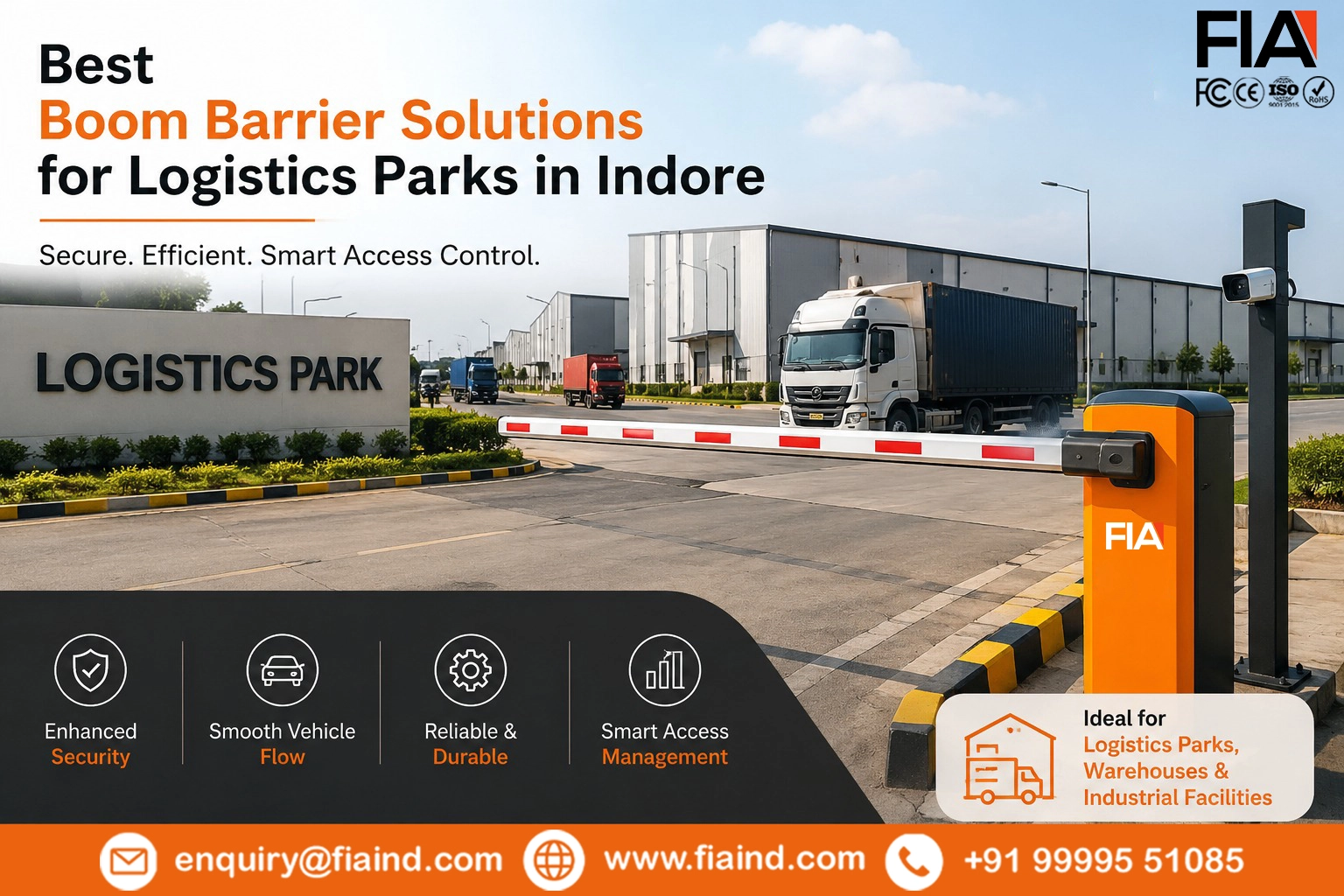
Indore has quietly become one of central India’s most important logistics hubs. With the Pithampur-Dhar-Mhow industrial corridor, the Indore-Ahmedabad and Indore-Bhopal freight routes, and a growing number of multi-modal logistics parks (MMLPs) coming up around the city, vehicle traffic in and out of warehousing zones has increased sharply over the last few years. More trucks, more shift changes, more visitors, and more security risk — all at the same gate.
This is exactly where a well-planned boom barrier system stops being a “nice to have” and becomes core infrastructure. At FIA (First Idea Automation), we work closely with warehouse operators, industrial park developers, and fleet management companies across Indore and Madhya Pradesh, and this article breaks down what actually matters when choosing a boom barrier for a logistics park — not just the boom barrier price in Indore, but the engineering, safety, and long-term maintenance decisions behind it.
Why Logistics Parks Need More Than a Basic Boom Barrier
A residential society and a logistics park may both use a “boom barrier,” but the operating conditions are completely different.
Logistics parks typically deal with:
- Heavy, long vehicles (trucks, trailers, container carriers) entering and exiting continuously
- 24×7 operations across multiple shifts
- High duty cycles — barriers opening and closing hundreds of times a day
- Dust, heat, and monsoon exposure typical of Indore’s climate
- The need to track vehicle entry/exit for compliance, billing, and security audits
A barrier designed for a housing society parking lot, opening 20–30 times a day, will wear out quickly under this kind of load. For a logistics park, you need a barrier rated for a heavy-duty cycle, with a robust motor, weatherproof housing, and — increasingly — smart integration with access control and fleet software.
Types of Boom Barriers Suited for Logistics Parks
1. Electromechanical Boom Barriers
The most common choice for medium-traffic logistics gates. They use a geared motor to raise and lower the boom arm and are cost-effective, easy to maintain, and suitable for boom lengths up to 4–6 metres, which comfortably covers most single-lane truck entries.
2. Hydraulic Boom Barriers
Built for high-frequency, heavy-duty use — exactly the profile of a busy logistics park or container yard. Hydraulic systems handle continuous opening and closing far better than electromechanical ones and are generally the recommended choice where trucks move in and out every few minutes throughout the day.
3. High-Speed Barriers
Useful at entry points where queue length needs to be minimised, such as shared logistics parks with multiple tenants and a single common gate.
4. RFID Boom Barriers
This is where logistics parks are increasingly investing, and for good reason.
RFID Boom Barrier: The Smart Choice for Logistics Parks
An RFID boom barrier pairs the barrier mechanism with an RFID reader and tags fitted on vehicles (or driver ID cards). Instead of a security guard manually checking each truck and lifting the barrier, the system automatically detects the tag as the vehicle approaches and opens the gate — provided the vehicle is authorised.
For a logistics park, this brings several practical advantages:
- Faster gate clearance: Trucks don’t need to stop for manual verification, which reduces queuing at peak dispatch hours.
- Automated logs: Every entry and exit is time-stamped and recorded, which is valuable for billing tenants, tracking dwell time, and audits.
- Reduced dependence on manual staff: Fewer chances of human error or unauthorised entry due to a distracted security guard.
- Integration with warehouse management systems (WMS): RFID data can feed directly into yard management or dock scheduling software, so a truck’s arrival automatically updates the loading queue.
- Better fleet visibility: Companies operating their own fleets can track which vehicles are on-site at any given time.
For logistics parks with multiple tenants sharing common gates, RFID also removes disputes — the system logs exactly which company’s vehicle entered and when, without relying on a manual register.
What Determines Boom Barrier Price in Indore
This is usually the first question warehouse and industrial park managers ask, and the honest answer is: it depends on the specification, not just the brand. Based on current market patterns for automatic boom barriers in India, the broad factors that move the price are:
- Boom arm length: Barriers covering wider entry lanes (for two trucks side by side, for example) cost more than standard single-lane arms.
- Drive mechanism: Electromechanical units are generally more affordable upfront; hydraulic units cost more but last longer under heavy daily cycles.
- Duty cycle rating: A barrier rated for continuous, high-frequency operation is priced higher than one meant for light residential use.
- RFID/ANPR integration: Adding an RFID reader, tags, or number-plate recognition cameras increases the initial investment but reduces manpower cost over time.
- Safety accessories: Photocells, loop detectors, LED indicators, and traffic lights add to the overall system cost but are strongly recommended for high-traffic truck gates.
- Installation and civil work: Foundation work, cabling, and electrical setup at the site also factor into the final quote.
Because of these variables, it’s worth being cautious of any vendor quoting a single flat number without first understanding your site’s traffic volume, lane width, and vehicle type. A logistics park handling heavy trucks around the clock has very different requirements — and a different price point — than an office parking lot. The right approach is to get a site assessment done and compare quotes for equivalent specifications, rather than comparing price alone.
What Makes a Boom Barrier “Best” for Your Logistics Park
When evaluating the best boom barrier in Indore for an industrial or logistics setting, look beyond the sticker price to these factors:
- Duty cycle rating matched to actual traffic — ask the vendor for the barrier’s rated cycles per hour and compare it honestly against your gate’s peak traffic.
- Local service support — a barrier that breaks down at 2 AM with no local technician available can stall an entire dispatch schedule. Choose a vendor with a service team based in or near Indore.
- Weatherproofing — Indore sees hot summers, a proper monsoon, and dusty industrial-area conditions. IP-rated enclosures and corrosion-resistant boom arms matter more here than in a controlled indoor environment.
- Compatibility with existing systems — if your park already uses a specific access control, CCTV, or WMS platform, confirm the barrier’s controller can integrate with it before purchase.
- Warranty and AMC terms — a genuine annual maintenance contract, not just a warranty on paper, is what keeps uptime high over years of heavy use.
- Safety certifications and sensors — anti-crush sensors, photocells, and auto-reverse functions are non-negotiable for a gate where large trucks are moving through daily.
Our Approach at FIA for Logistics Park Projects
At First Idea Automation, our process for logistics park clients in Indore typically starts with a site visit to measure lane width, assess vehicle type and frequency, and understand shift patterns. Based on that, we recommend a barrier type — electromechanical or hydraulic — sized correctly for the boom length and duty cycle required, and we discuss whether RFID or ANPR integration makes sense given the number of vehicles and tenants using the gate.
We’ve supported access control and automation projects across a range of industrial and commercial sites in the Indore region, and one consistent lesson has held true: barriers that are undersized for the actual traffic volume fail far sooner than expected, and the cost of premature replacement or frequent repair usually outweighs the small upfront saving of buying a lighter-duty unit.
Installation and Maintenance Tips for Logistics Parks
- Schedule barrier maintenance around low-traffic hours to avoid disrupting dispatch schedules.
- Keep a basic spare parts kit (fuses, photocell sensors, remote batteries) on-site to handle minor faults without waiting for a technician.
- Train security staff on manual override procedures in case of a power failure, so trucks aren’t held up unnecessarily.
- Log barrier faults over time — recurring issues often point to a duty-cycle mismatch rather than a manufacturing defect.
- Clean and inspect the boom arm and hinge points periodically, especially after the monsoon season, when dust and moisture combine to accelerate wear.
Frequently Asked Questions
Is an RFID boom barrier worth it for a small logistics park with only a few tenants? If vehicle entries are infrequent and mostly known vehicles, a standard automatic barrier with a security guard may be sufficient initially. RFID becomes clearly cost-effective once daily vehicle movement crosses a few dozen entries, or when multiple tenants share a single gate and need separate tracking.
How long does a boom barrier typically last in a high-traffic logistics setting? With correct sizing for the duty cycle and regular maintenance, a well-installed barrier can operate reliably for several years. Choosing a barrier rated for your actual traffic volume — rather than the cheapest available option — has the biggest impact on lifespan.
Can an existing manual boom barrier be upgraded to RFID? In many cases, yes — an RFID reader and controller can be retrofitted to an existing barrier, provided the mechanical unit is in good working condition. A site inspection is the best way to confirm compatibility.
Final Thoughts
Choosing the right boom barrier for a logistics park in Indore isn’t just about comparing the lowest boom barrier price in Indore — it’s about matching the barrier’s duty cycle, build quality, and integration capability to how your gate actually operates, day after day, truck after truck. Get the sizing and specification right at the start, and the barrier quietly does its job for years without becoming a bottleneck in your operations.
If you’re evaluating boom barrier or access control solutions for a logistics park, warehouse, or industrial facility in Indore, FIA (First Idea Automation) can carry out a site assessment and recommend a system suited to your traffic and budget.