
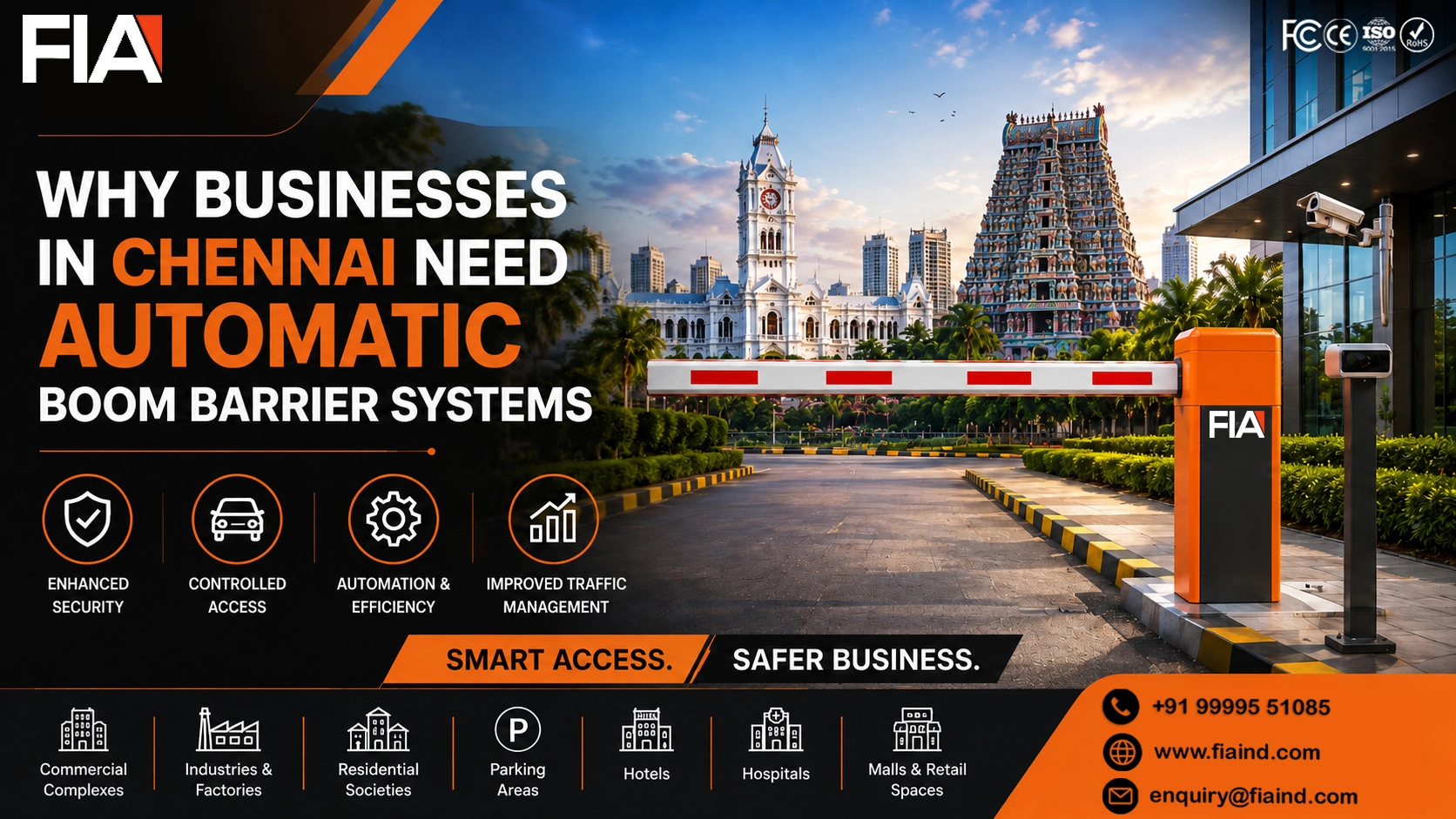
Chennai’s business landscape is growing faster than ever. From IT parks in OMR and Sholinganallur to manufacturing hubs in Ambattur and warehousing clusters near the port, every commercial property in the city shares one common challenge: managing who enters, who exits, and how safely it happens.
If your business still relies on a manual gate, a security guard waving vehicles through, or a simple chain-link barrier, you’re not just risking security gaps — you’re also losing time, money, and control over your premises.
This is where automatic boom barrier systems come in. They have quickly become a standard requirement for offices, factories, residential complexes, hospitals, malls, and logistics parks across Chennai. In this guide, we’ll break down exactly why your business needs one, how it works, and what to look for before you invest.
What Is an Automatic Boom Barrier System?
An automatic boom barrier is a motorized arm or pole that rises and lowers to control vehicle entry and exit at a gate, checkpoint, or parking facility. Unlike a manual barrier that needs a person to physically lift or push it, an automatic system is operated through:
- Remote controls
- RFID or vehicle tags
- Access cards or biometric readers
- Number plate recognition (ANPR) cameras
- Mobile app-based triggers
The barrier arm — usually made of aluminum, GRP (glass reinforced plastic), or steel — opens and closes in 1 to 3 seconds, allowing smooth and controlled traffic flow without constant manual intervention.
Why Chennai Businesses Specifically Need This Technology
1. Rapid Urban Growth Means Higher Vehicle Density
Chennai has seen consistent growth in commercial real estate, IT corridors, and industrial zones over the past decade. More employees, more visitors, more delivery vehicles, and more logistics traffic mean gate congestion is a daily reality for many businesses. An automatic boom barrier reduces bottlenecks by processing vehicles in seconds rather than minutes.
2. Security Is No Longer Optional
Unauthorized entry, theft, and vehicle-related incidents are serious concerns for any commercial property. A boom barrier integrated with access control ensures that only verified vehicles — employees, tenants, or approved visitors — can enter the premises. This is especially critical for:
- IT parks and corporate campuses handling sensitive data
- Manufacturing units with expensive machinery and inventory
- Warehouses and logistics hubs with high-value goods movement
- Gated residential and commercial complexes
3. Chennai’s Climate Demands Durable, Weatherproof Equipment
Chennai experiences intense heat, humidity, and heavy monsoon rains. A poorly built manual barrier or a low-quality automatic system can corrode, jam, or malfunction under these conditions. Businesses need boom barriers built with weather-resistant housing, rust-proof coatings, and IP-rated motors designed to perform reliably through Chennai’s climate extremes.
4. Rising Labor Costs Make Manual Gate Management Expensive
Employing security personnel exclusively to manually operate gates around the clock is costly and inefficient. An automatic system reduces dependency on manual labor at the gate, allowing security staff to focus on surveillance, patrolling, and incident response instead of repetitive gate operation.
5. Regulatory and Insurance Expectations Are Increasing
Many commercial insurance providers and industrial safety audits now expect documented, controlled access systems as part of risk management. Having an automatic boom barrier with logged entry/exit data can support compliance requirements and may even help reduce insurance premiums over time, depending on your provider’s policy.
Key Business Benefits of Installing an Automatic Boom Barrier
Faster Traffic Flow
Automatic barriers open and close within seconds, drastically cutting down wait times at entry points — especially valuable during shift changes, delivery windows, or peak visitor hours.
Enhanced Perimeter Security
When paired with CCTV, ANPR cameras, and access control software, a boom barrier becomes part of a layered security system that logs every vehicle movement, creating an audit trail for investigations if needed.
Reduced Operational Costs
Fewer personnel are required at the gate, and automated systems reduce the wear and human error associated with manual barrier operation.
Professional Brand Image
A modern, automated entry point signals professionalism to clients, partners, and visitors — reinforcing that your business takes security and efficiency seriously.
Data-Driven Insights
Advanced boom barrier systems can log entry and exit timestamps, vehicle numbers, and visitor patterns, giving facility managers useful data for planning staffing, parking allocation, and security audits.
Integration With Broader Security Infrastructure
Modern boom barriers can be integrated with:
- Visitor management systems
- Parking guidance systems
- Time and attendance software
- Building management systems (BMS)
This makes them a foundational component of a smart, connected facility rather than a standalone device.
Industries in Chennai That Benefit Most
| Industry | Why It Matters |
| IT Parks & Corporate Offices | Secure employee and visitor entry, reduce tailgating risk |
| Manufacturing & Industrial Units | Protect equipment, manage vendor and logistics traffic |
| Warehouses & Logistics Hubs | Control high volumes of trucks and delivery vehicles efficiently |
| Hospitals & Healthcare Campuses | Manage ambulance access, staff parking, and visitor flow |
| Residential & Commercial Complexes | Restrict entry to residents/tenants and pre-approved guests |
| Educational Institutions | Control vehicle access during and outside school/college hours |
| Retail Malls & Shopping Complexes | Manage high footfall parking areas smoothly |
Types of Automatic Boom Barriers to Consider
Not every business needs the same barrier. Choosing the right type depends on traffic volume, budget, and security requirements:
- Straight Arm Barriers – Best for standard-width entry points with moderate traffic.
- Folding Arm Barriers – Ideal for narrower spaces where a straight arm can’t fully extend.
- Telescopic Arm Barriers – Suited for wide roads or multi-lane entrances.
- High-Speed Barriers – Designed for high-traffic industrial or logistics facilities where speed is critical.
- Hydraulic vs. Electromechanical Barriers – Hydraulic systems suit heavy-duty, high-frequency use; electromechanical systems are typically more cost-effective for moderate use.
What to Look for Before Choosing a Boom Barrier Vendor in Chennai
Before investing, businesses should evaluate:
- Build quality – Rust-resistant materials suited to Chennai’s humid, coastal climate
- Speed and cycle rating – How many open/close cycles per hour the motor can handle
- Safety features – Auto-reverse sensors, photocell/infrared beams to prevent collision, battery backup for power outages
- Integration compatibility – Ability to connect with existing CCTV, access control, or visitor management systems
- After-sales support – Local service availability, warranty terms, and maintenance response time
- Certifications and standards compliance – Confirm the equipment meets relevant safety and electrical standards
Working with an experienced, locally established provider ensures faster installation, easier maintenance access, and support that understands Chennai’s specific environmental and traffic conditions.
Common Questions Businesses Ask
Q: Are automatic boom barriers expensive to maintain? Maintenance costs are generally low when the system is installed correctly and serviced periodically. Preventive maintenance (lubrication, sensor checks, software updates) typically costs far less than the losses from security breaches or gate downtime.
Q: Can boom barriers work during power cuts? Most quality systems come with battery backup, and many also offer manual override options so operations aren’t disrupted during outages — an important consideration given Chennai’s occasional power fluctuations during monsoon season.
Q: How long does installation take? Depending on site conditions and civil work required, installation typically takes anywhere from a day to about a week for a standard commercial setup.
Q: Can one system handle both entry and exit lanes? Yes, many facilities use a dual-barrier setup — one for entry and one for exit — each independently controlled but connected to the same access management system.
Final Thoughts
For Chennai businesses, an automatic boom barrier system isn’t just about convenience — it’s about protecting assets, controlling access, improving traffic flow, and presenting a professional, security-conscious image to employees, clients, and visitors alike. As commercial activity in the city continues to expand, the businesses that invest in reliable, well-integrated access control infrastructure today will be better positioned to scale operations safely and efficiently tomorrow.
If you’re evaluating boom barrier options for your facility, it’s worth consulting with a provider who understands both the technical requirements and the local operating conditions unique to Chennai — from climate durability to traffic patterns specific to your industry.
Looking for a reliable automatic boom barrier system for your business in Chennai? Get in touch with our team to discuss the right solution for your facility’s security and traffic management needs.