
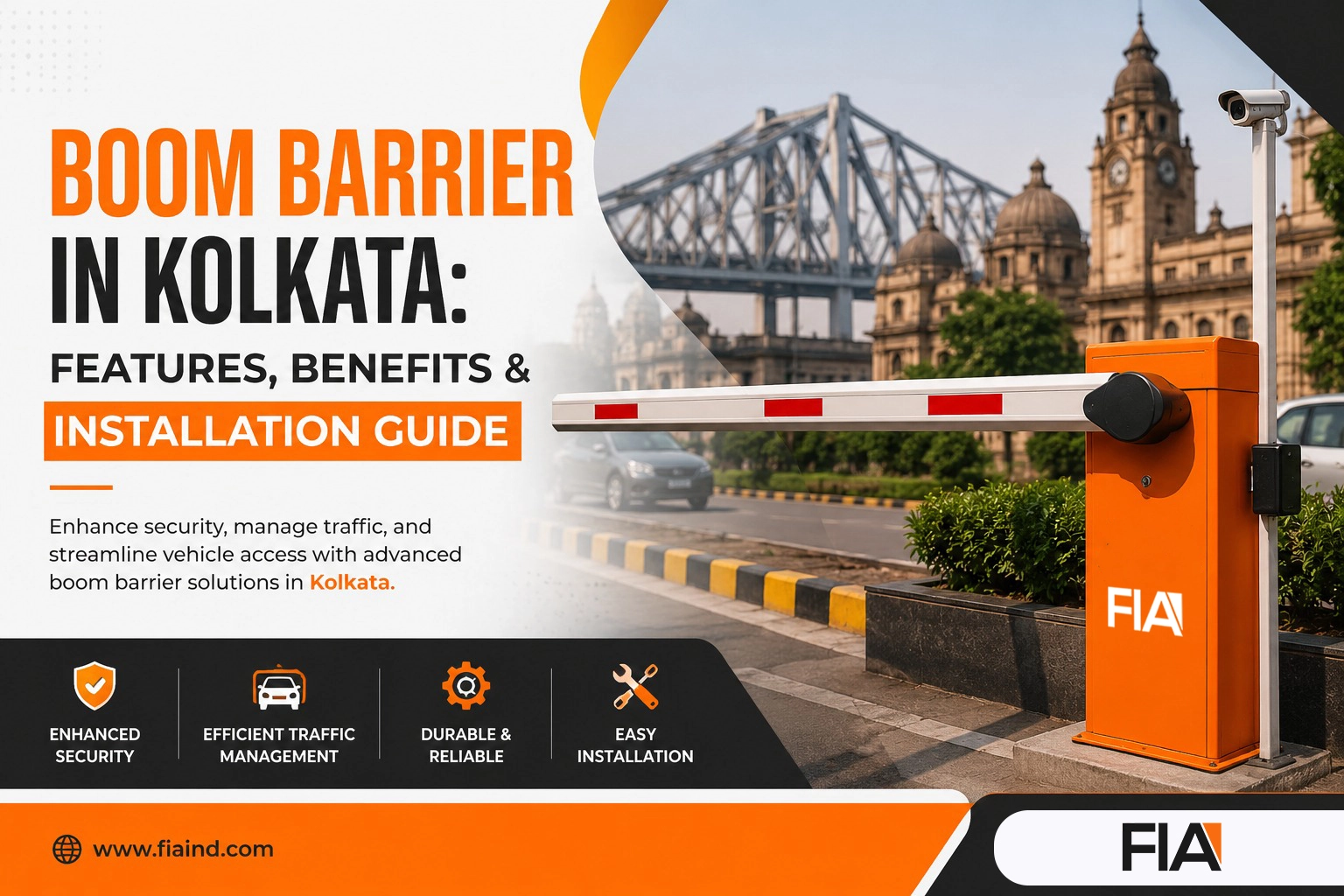
Kolkata’s mix of gated residential complexes, industrial estates, IT parks, and busy commercial hubs has created a steady demand for reliable vehicle access control. Whether it’s a housing society in Rajarhat, a warehouse in Howrah, or a corporate campus in Salt Lake, a boom barrier in Kolkata has become one of the most practical ways to manage traffic flow, restrict unauthorized entry, and add a visible layer of security.
At FIA (First Idea Automation), we’ve spent years installing and servicing automated access control systems across Kolkata and the wider West Bengal region. This guide draws on that hands-on experience to help you understand what boom barriers actually do, the types available, the features worth prioritizing, and what a proper installation involves — so you can make an informed decision for your property.
What Is a Boom Barrier?
A boom barrier (also called a boom gate or arm barrier) is an automated or manually operated system that uses a horizontal arm to block and allow vehicle movement at an entry or exit point. Unlike swing or sliding gates, boom barriers are designed specifically for fast-moving, high-frequency vehicular traffic — making them ideal for parking lots, toll points, residential society gates, factory entrances, and commercial complexes.
The arm typically pivots at 90 degrees, rising to let a vehicle pass and lowering to block the lane again. Most modern systems in Kolkata now use motorized boom barriers controlled through remote access, RFID cards, ANPR (Automatic Number Plate Recognition) cameras, or integration with a wider society management app.
Why Kolkata Properties Are Adopting Boom Barriers
Kolkata’s urban density means many residential and commercial spaces have limited entry points that see heavy vehicle movement during peak hours. A few local factors are driving adoption:
- Rising vehicle theft and unauthorized entry concerns in gated communities across areas like New Town, Rajarhat, and Salt Lake
- Traffic management needs at IT parks and business hubs like Sector V
- Monsoon durability requirements — Kolkata’s humid climate and heavy monsoon rainfall mean equipment needs to be built for weather resistance
- Growing RWA (Resident Welfare Association) push for automated, loggable entry systems instead of manual guard-operated gates
Because of these conditions, boom barriers installed in Kolkata typically need slightly different specifications than those used in drier states — something worth discussing with your installer before finalizing a system.
Types of Boom Barriers Available in Kolkata
1. Manual Boom Barriers
Operated by hand, these are lower-cost and suited to low-traffic entry points where automation isn’t essential. Common in smaller commercial plots or low-footfall parking areas.
2. Automatic (Motorized) Boom Barriers
These use an electric or hydraulic motor to raise and lower the arm, controlled via remote, push-button, or sensor. Most residential societies and offices in Kolkata now prefer this type for convenience and consistent operation.
3. Hydraulic Boom Barriers
Best suited for high-traffic or heavy-duty locations such as toll plazas, large industrial gates, or commercial complexes with continuous vehicle movement. Hydraulic systems offer smoother, quieter operation and longer service life under frequent use.
4. RFID/Automatic Boom Barriers with Access Control
Integrated with RFID tags, biometric access, or ANPR cameras, these systems automatically identify authorized vehicles and open the barrier without manual intervention — increasingly popular in premium residential complexes and corporate campuses in Kolkata.
Key Features to Look For
When evaluating a boom barrier for your Kolkata property, these features make a real difference in day-to-day performance:
Arm Length and Material Boom arms typically range from 3 to 6 meters. Choose based on your lane width — an undersized arm won’t cover the full road width, while an oversized one adds unnecessary strain on the motor. Aluminum or fiber-reinforced arms resist corrosion better in Kolkata’s humid conditions.
Opening and Closing Speed For high-traffic entry points, faster cycle times (2–6 seconds) reduce queuing. Residential gates can work well with standard speeds, while commercial and industrial gates benefit from faster mechanisms.
Weatherproofing (IP Rating) Kolkata’s monsoon season puts real stress on outdoor electronics. Look for barriers with at least an IP44 or higher rating, and housings that protect internal components from moisture and dust.
Battery Backup Given Kolkata’s occasional power fluctuations, a boom barrier with built-in battery backup ensures the system keeps working during outages — a feature many local installers now include as standard.
Obstacle Detection Sensors Safety sensors that stop or reverse the arm if it detects a vehicle or person underneath are essential for busy access points, especially where pedestrians and vehicles share the same lane.
Remote and App-Based Control Integration with RFID cards, remote controls, or smartphone apps allows security staff or residents to manage access without constant manual operation.
LED Arm and Warning Lights Especially useful for low-visibility conditions such as heavy monsoon rain or foggy winter mornings, which are common in Kolkata.
Benefits of Installing a Boom Barrier
Enhanced Security A boom barrier acts as the first physical checkpoint, preventing unauthorized or unidentified vehicles from entering the premises without proper clearance.
Better Traffic Management In gated communities or corporate parks with multiple resident or employee vehicles, boom barriers help regulate flow and reduce congestion at entry and exit points, particularly during rush hours.
Reduced Dependency on Manual Guarding While security personnel remain important, automated barriers reduce the physical effort and constant attention required to manage a gate manually, letting guards focus on broader premise security.
Access Logging and Accountability RFID and ANPR-based systems create a digital log of vehicle entries and exits — useful for society management, audits, or investigating any security incident.
Low Maintenance, Long Service Life Quality boom barriers, when installed and maintained correctly, typically require minimal upkeep and can operate reliably for years, even under Kolkata’s demanding weather conditions.
Professional Appearance Beyond function, an automated boom barrier gives residential and commercial properties a more organized, professional look at the entrance — often a factor in property valuation and tenant perception.
Boom Barrier Installation Process: What to Expect
A proper installation isn’t just about bolting a machine to the ground. Based on our field experience across Kolkata properties, here’s what a competent installation process typically involves:
1. Site Survey and Assessment The installer evaluates lane width, traffic volume, power availability, ground conditions, and any specific requirements (like monsoon drainage near the entry point).
2. Choosing the Right Boom Barrier Type Based on the survey, the appropriate barrier type — manual, motorized, hydraulic, or access-control integrated — is recommended to match the property’s actual usage pattern, not a generic default.
3. Civil Work and Foundation A concrete foundation is prepared to anchor the barrier housing securely. This step is critical in areas with waterlogging risk during monsoons, where poor foundation work can lead to premature equipment failure.
4. Electrical Wiring and Control Panel Setup Power supply, control panel, and any integrated sensors or RFID readers are wired and configured. Battery backup units are also installed at this stage if included.
5. Mounting and Calibration The barrier unit is mounted, the arm attached, and the system calibrated for correct opening angle, speed, and sensor sensitivity.
6. Testing and Safety Checks Before handover, the system is tested for obstacle detection, backup power function, remote/app connectivity, and overall reliability under repeated cycles.
7. Staff Training and Handover Security staff or facility managers are briefed on day-to-day operation, troubleshooting basics, and emergency manual override procedures.
8. Annual Maintenance Support Ongoing maintenance — checking hydraulic fluid levels, motor condition, sensor calibration, and weatherproofing — helps extend the system’s working life, particularly important given Kolkata’s climate.
Choosing the Right Boom Barrier Provider in Kolkata
Not every installer offers the same level of service. When comparing providers, consider:
- Experience with local site conditions (monsoon-proofing, power backup needs)
- Availability of after-sales service and spare parts in Kolkata
- Warranty terms on both equipment and installation workmanship
- Ability to customize the system (arm length, access control integration, branding)
- Genuine customer references from similar properties in the city
At FIA (First Idea Automation), our teams handle everything from the initial site survey to installation and long-term maintenance, with a focus on solutions built specifically for Kolkata’s climate and traffic conditions.
Frequently Asked Questions
Is a boom barrier suitable for a residential society in Kolkata? Yes. Most gated residential complexes in Kolkata use automatic boom barriers combined with RFID access for resident vehicles, paired with manual override for visitors and staff.
How long does installation typically take? For a standard motorized boom barrier, installation usually takes one to two days, depending on civil work requirements and site conditions. Hydraulic or heavily customized systems may take slightly longer.
Do boom barriers work well during Kolkata’s monsoon season? Yes, provided the unit has an appropriate IP rating, proper foundation drainage, and weatherproof housing. This is why local site assessment matters more than picking a generic, one-size-fits-all system.
Can an existing manual gate be upgraded to an automatic boom barrier? In most cases, yes. An installer will assess the existing structure, power availability, and lane width to determine the right retrofit approach.
What maintenance does a boom barrier need? Routine checks on motor function, sensor calibration, arm alignment, and battery backup are recommended periodically, along with a professional annual service visit.
Final Thoughts
A boom barrier is no longer just an optional add-on for Kolkata properties — it’s becoming a standard part of access management for residential societies, offices, and industrial sites across the city. Choosing the right type, prioritizing weatherproof and safety features suited to local conditions, and working with an experienced local installer are the key factors that determine how well the system performs over time.
If you’re evaluating boom barrier options for your property in Kolkata, FIA (First Idea Automation) can walk you through a site assessment and recommend a system suited to your specific traffic, security, and climate requirements.