
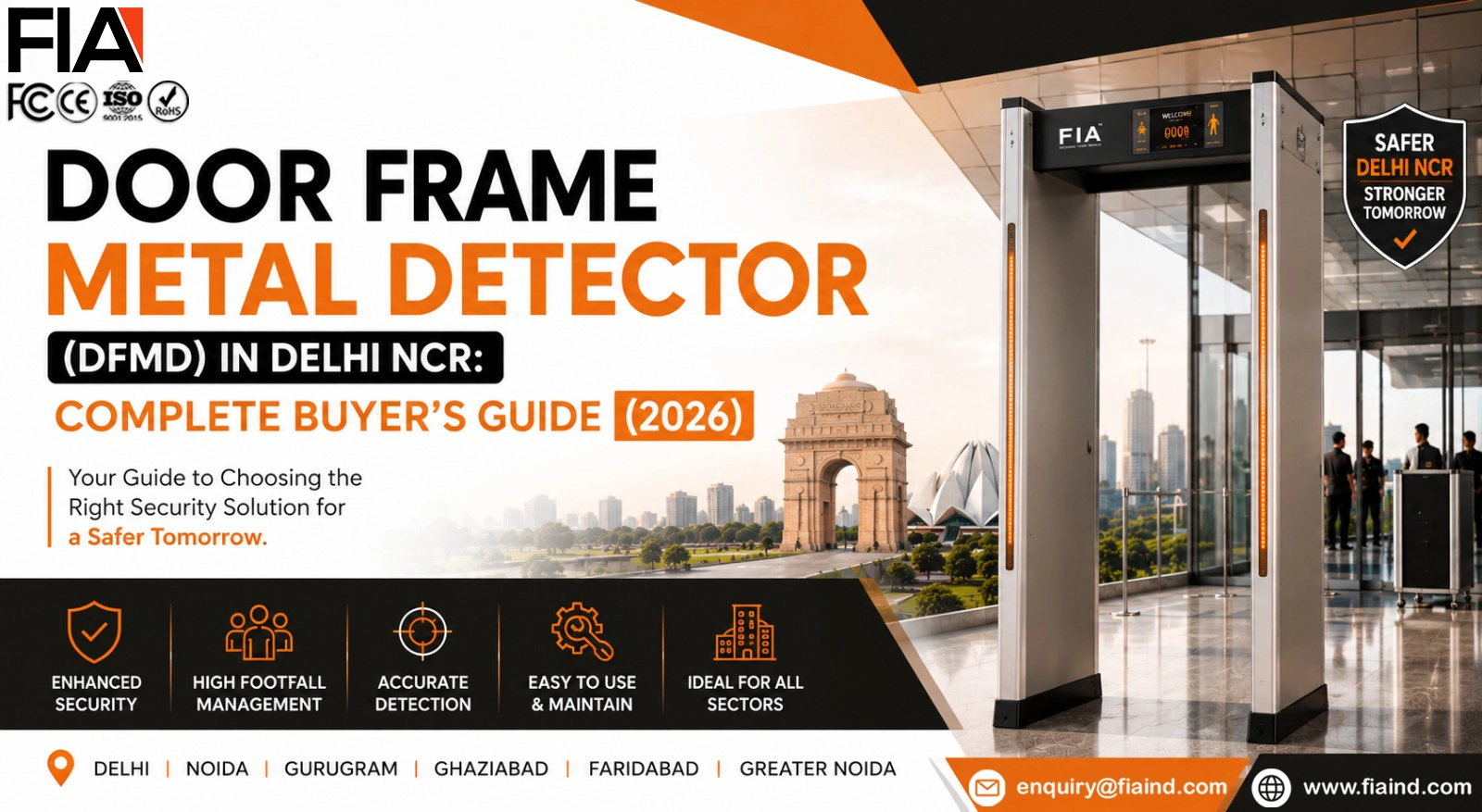
Security threats don’t announce themselves in advance, and that’s exactly why every serious facility manager, hotel owner, school administrator, or event planner in Delhi NCR is now treating a Door Frame Metal Detector (DFMD) as a non-negotiable part of their access control setup. Whether you’re securing a corporate office in Gurugram, a residential society in Noida, a wedding venue in South Delhi, or a government building, choosing the right DFMD can be the difference between effective screening and a false sense of security.
This guide breaks down everything you need to know before buying a DFMD in Delhi NCR — types, specifications, pricing, compliance, installation, and the questions you should be asking suppliers before you sign a purchase order.
What is a Door Frame Metal Detector and How Does It Work?
A Door Frame Metal Detector is a walk-through security screening device installed at entry points to detect ferrous and non-ferrous metal objects carried by a person. It works on the principle of electromagnetic field disturbance: the unit emits a low-frequency magnetic field across the doorway, and when a metallic object (a knife, firearm component, or other concealed item) passes through, it disrupts that field. The control unit registers this disturbance and triggers a visual and audible alarm, alerting security personnel to conduct a manual check.
Unlike handheld metal detectors, which require a security guard to manually scan each visitor, a DFMD provides continuous, hands-free screening of every person who walks through it. This makes it the preferred choice for high-footfall locations where speed and consistency matter as much as accuracy.
Why Demand for DFMDs is Rising Across Delhi NCR
Delhi NCR has seen a sharp uptick in DFMD installations over the last few years, driven by a combination of factors:
Corporate campuses in Gurugram, Noida, and Greater Noida are tightening perimeter security following industry-wide audits and insurance requirements. Residential welfare associations (RWAs) across gated communities in Noida and Dwarka are installing DFMDs at main gates as part of broader societal security upgrades. Educational institutions, from schools to coaching centers, are adopting DFMDs to comply with safety guidelines issued after various security incidents nationwide. Hotels, banquet halls, and event venues frequently rent or purchase portable DFMDs, especially during the wedding and festival season (Navratri, Diwali, and similar high-footfall periods). Government offices, courts, and metro stations continue to rely on multi-zone DFMDs as part of standard security protocol.
This growing demand has also led to a wider variety of suppliers entering the Delhi NCR market, which makes it even more important for buyers to know what separates a reliable unit from a poor one.
Single Zone vs Multi-Zone DFMD: Which One Do You Need?
One of the first decisions you’ll face is choosing between a single-zone and a multi-zone detector.
A single-zone DFMD treats the entire doorway as one detection area. When metal is detected anywhere on a person’s body, the unit simply triggers an alarm without indicating where the metal is located. It is used to monitor and trigger alarms when someone enters or exits through a certain door. This type is generally suitable for lower-risk environments such as small offices, retail stores, or residential complexes where a quick yes/no detection is sufficient.
A multi-zone DFMD divides the doorway into multiple vertical detection zones — commonly 6, 12, 18, or even 33 zones in advanced models. This type of detector can identify whether a person has crossed through one section of the entrance. When an alarm is triggered, an LED indicator shows approximately where on the body the metal object is located, allowing security staff to conduct a faster, more targeted pat-down. A multi zone DFMD indicates the approximate location of the metal object on the body for faster inspection.
For high-security environments, the choice is clear. Multi zone Door Frame Metal Detectors are suitable for high-security locations such as airports, defence areas, metro stations, government buildings, and critical infrastructure facilities. If you’re securing a corporate headquarters, a large event, or any facility with significant footfall, a multi-zone unit (12-zone or higher) is the smarter long-term investment, even at a slightly higher upfront cost.
Key Features to Evaluate Before You Buy
Not all DFMDs are built the same, even when they look identical on a brochure. Here’s what actually matters during evaluation:
Sensitivity and discrimination control. A good DFMD should allow you to adjust sensitivity levels and discriminate between harmless metal objects (belt buckles, jewelry, keys) and genuine threats. The detector can discriminate between different types of metals and can be programmed to ignore harmless metals such as jewelry or belt buckles. Without this feature, you’ll face constant false alarms, which slows down screening and frustrates visitors.
LED indicators and visual alarm bars. LED light bars running down both door panels give security staff an instant visual cue of where detection occurred, especially useful in noisy environments where audible alarms might be missed.
Counter functionality. Many modern units come with built-in people counters, tracking the number of individuals who have passed through — useful for footfall analytics in malls, offices, and event venues.
Power supply and battery backup. Look for units that support both mains power (220-230V) and rechargeable battery operation. This is especially important for outdoor events or locations with unreliable power supply, which is still a consideration in parts of NCR during peak summer months.
Build material and weather resistance. ABS plastic bodies are standard for indoor use, but if the unit will be placed at outdoor entrances (common for farmhouses, banquet halls, and open event venues), check for weatherproofing and IP-rated components.
Compliance and certification. Always ask suppliers whether the unit conforms to recognized international or national security screening standards. Reputable manufacturers will readily share test certifications and compliance documentation — if a supplier is vague about this, treat it as a red flag.
What Drives the Cost of a DFMD
While exact pricing varies widely across suppliers, it helps to understand the factors that influence cost so you can evaluate quotations sensibly. The DFMD price in India depends on the model, zone type, sensitivity level, application, installation requirement, and customization. Multi-zone units with advanced features and branded components (such as Garrett, CEIA, or Rapiscan-grade technology) generally cost more than basic single-zone models, but they also offer better discrimination, durability, and long-term reliability.
Rather than chasing the lowest quoted price, it’s worth requesting an itemized quote that separates the unit cost, installation charges, warranty terms, and any annual maintenance contract (AMC). A cheaper unit that lacks a service network in Delhi NCR can end up costing far more in downtime and repair logistics over its lifetime.
Where DFMDs Are Commonly Deployed in Delhi NCR
Understanding common deployment scenarios can help you benchmark your own requirements:
Corporate offices and IT parks across Gurugram’s Cyber City, Noida Sector 62, and Greater Noida West typically deploy multi-zone DFMDs at main lobby entrances, often integrated with visitor management systems. Educational campuses install units at main gates, with security staff trained to conduct secondary checks on alarm triggers. Malls and retail complexes, such as those in Vasant Kunj, Saket, and DLF Mall of India, use high-throughput multi-zone units designed for continuous operation across long hours. Hotels and banquet halls frequently opt for portable units that can be moved between entrances depending on event layout — portable door frame metal detectors with ABS material, battery operation, and auto-tuning are popular for this exact reason. Religious and community gathering spaces, particularly during festival seasons, often rent rather than purchase, given the seasonal nature of demand. Rental options for hand-held and door frame metal detectors are commonly offered specifically for occasions like Navratri and Ganesh Utsav celebrations.
Buy vs Rent: What Makes Sense for Your Situation?
If your security requirement is permanent — a corporate office, school, residential complex, or government building — purchasing a DFMD outright is almost always more cost-effective over a 3-5 year horizon, especially when you factor in an AMC for servicing and calibration.
If your requirement is occasional — a wedding season, a one-off corporate event, a religious gathering, or a temporary exhibition — renting a portable DFMD makes far more financial sense. Several Delhi NCR suppliers offer short-term rental packages that include delivery, setup, and pickup, which removes the burden of storage and maintenance for equipment you’ll only use a few times a year.
Installation and Maintenance Considerations
A DFMD is only as effective as its installation and upkeep. A few practical points worth discussing with your supplier:
Placement matters. DFMDs should be installed away from large metal structures, electrical panels, or escalators, as these can interfere with the magnetic field and cause inconsistent readings. Calibration is not a one-time task. Sensitivity settings often need periodic recalibration, especially in high-traffic locations where dust, humidity, or vibration can affect performance over time. Staff training is essential. Even the most advanced multi-zone DFMD is ineffective if security personnel don’t know how to interpret zone indicators or respond appropriately to alarms. Service network matters more than brand name. Before purchasing, confirm that the supplier has technicians available within Delhi NCR for repairs, calibration, and warranty support — not just a regional office that routes service requests elsewhere.
Questions to Ask Before You Finalize a Supplier
When evaluating DFMD suppliers in Delhi NCR, a few direct questions can save you significant trouble later:
Does the unit come with a documented warranty period, and what exactly does it cover? Can you provide test/calibration certificates and compliance documentation for the model? What is the typical response time for service calls within Delhi NCR? Is an AMC available, and what does it include — calibration visits, part replacement, or both? Can the unit be demonstrated on-site before purchase, using realistic test objects?
A supplier who answers these questions clearly and provides documentation without hesitation is generally a safer bet than one offering the lowest price with vague answers.
Final Thoughts
Choosing a Door Frame Metal Detector for your Delhi NCR property isn’t just a procurement decision — it’s a core part of your security infrastructure that directly affects how safe people feel and how effectively threats are screened. Take the time to assess your footfall, risk profile, and budget realistically, prioritize multi-zone units for higher-risk environments, and work with suppliers who can back up their claims with documentation and local service support.
For organizations looking to benchmark their security equipment against industry standards or seeking guidance on compliant security infrastructure, staying informed through industry associations and verified suppliers remains the safest path forward.