
Introduction
Physical perimeter security has never been more critical. Whether protecting a government facility, a corporate campus, a logistics hub, or a high-traffic public space, organisations across industries are turning to tyre killer systems as a frontline defence against unauthorised vehicle entry.
A tyre killer system — also known as a road spike barrier or vehicle tyre deflation device — is engineered to puncture the tyres of vehicles attempting to breach a controlled access point without authorisation. When deployed correctly, these systems are among the most reliable and cost-effective vehicle access control solutions available today.
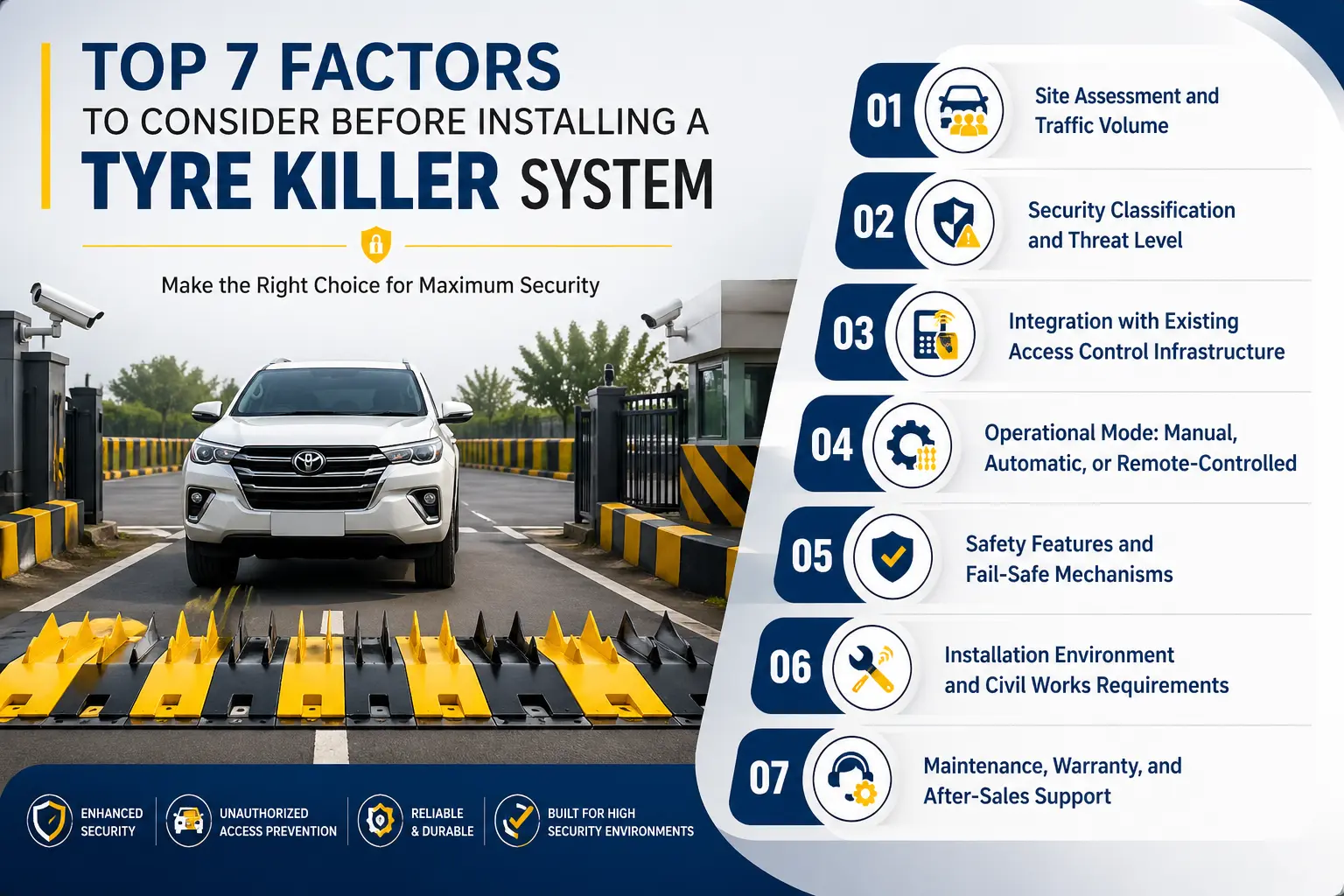
But effective deployment begins long before the installation crew arrives on-site. Making the wrong choices at the planning stage can lead to security gaps, operational disruptions, and costly retrofits. At First Idea Automation (FIA), we have guided hundreds of clients through this decision-making process. Based on that experience, here are the seven most important factors to evaluate before installing a tyre killer system.
1. Site Assessment and Traffic Volume
Every installation starts with a thorough site assessment. The physical characteristics of your location will shape virtually every other decision you make.
Ask yourself: How many vehicles pass through this access point daily? Are they light passenger cars, heavy goods vehicles, or a mix? What is the ground composition — asphalt, concrete, or unpaved terrain? Is the entry point wide, narrow, or irregular in shape?
A tyre killer system sized for light-duty traffic will not perform reliably under the repeated stress of heavy trucks. Similarly, a system designed for a single-lane checkpoint may be entirely unsuitable for a multi-lane entry with high throughput. Conducting a proper site survey — ideally with input from a qualified security consultant — ensures that the system you select matches the real-world demands of your location.
2. Security Classification and Threat Level
Not all security environments are created equal. A retail car park has very different threat parameters than a military installation or a government ministry. Before specifying any tyre killer system, clearly define the threat level you are designing against.
Industry standards such as PAS 68 (UK) and IWA 14-1 (international) provide certified impact test ratings for hostile vehicle mitigation (HVM) products. These ratings indicate the maximum vehicle weight and speed a barrier can stop. Choosing a system with the appropriate certification for your threat profile is not just best practice — in many cases, it is a regulatory or contractual requirement.
Working with a supplier like FIA that understands these classifications ensures your system meets the necessary performance benchmarks without over-specifying (and over-spending) for threats that do not apply to your context.
3. Integration with Existing Access Control Infrastructure
A tyre killer system rarely operates in isolation. In modern security ecosystems, it needs to communicate with — and respond to — other systems already in place, such as:
- Boom barriers and automatic gates
- ANPR (Automatic Number Plate Recognition) cameras
- Intercom and guard management systems
- CCTV and surveillance networks
- Building management systems (BMS)
The ability to integrate seamlessly with your existing infrastructure is a decisive factor. A road spike barrier that cannot be synchronised with your gate controller, for example, creates operational friction and potential security gaps. Before purchasing, verify that the system supports the communication protocols and control interfaces used by your current setup. FIA specialises in designing integrated security solutions where every component speaks the same language.
4. Operational Mode: Manual, Automatic, or Remote-Controlled
How will the tyre killer system be triggered? This is one of the most practically important questions you will need to answer.
Manual operation places control in the hands of a security officer on-site. This is appropriate for locations with a staffed gatehouse where guard judgement is central to the access decision.
Automatic operation links the system to an ANPR camera or access control reader. When an authorised vehicle is detected, the spikes retract; when an unknown vehicle approaches, they remain raised. This mode suits high-throughput environments where human processing would create bottlenecks.
Remote-controlled operation allows a centralised security team to manage multiple access points from a single control room, ideal for large campuses or organisations with limited on-ground staffing.
Understanding your operational workflow before selecting a system ensures the technology supports — rather than complicates — your security processes.
5. Safety Features and Fail-Safe Mechanisms
Any system that can physically disable a vehicle carries inherent safety responsibilities. A robust tyre killer system must include comprehensive safety provisions to protect authorised users, pedestrians, and emergency vehicles.
Key safety features to look for include:
- Fail-safe positioning: The system should default to a safe state (spikes down or retracted) in the event of a power failure, preventing accidental tyre damage to authorised vehicles.
- Safety edge sensors: These detect obstructions — such as a person or object in the path of the system — and halt movement immediately.
- Warning indicators: Visual (flashing lights) and audible (sirens or buzzers) alerts warn approaching drivers that the system is active.
- Emergency override: Security personnel must be able to quickly override the system to allow emergency vehicles through without delay.
Do not compromise on safety specifications. A system that injures a legitimate visitor or delays an ambulance represents a serious liability for your organisation.
6. Installation Environment and Civil Works Requirements
The hidden complexity of any tyre killer installation often lies beneath the surface. The civil engineering requirements — groundwork, drainage, power cabling, and foundation preparation — can significantly affect both project cost and timeline.
Consider the following environmental factors:
- Ground stability: Soft or waterlogged ground may require additional reinforcement before the system can be installed.
- Drainage: Tyre killer units installed in low-lying areas or regions with heavy rainfall need integrated drainage channels to prevent flooding and mechanical damage.
- Power supply: Is there an existing power source nearby, or will new cabling need to be routed to the installation point?
- Underground utilities: Always carry out utility mapping before breaking ground to avoid damaging existing pipes, cables, or drainage systems.
FIA’s installation teams conduct a detailed civil works assessment as part of every project, providing clients with a transparent picture of what the groundwork will involve before contracts are signed.
7. Maintenance, Warranty, and After-Sales Support
A tyre killer system is a long-term infrastructure investment. Like any mechanical and electrical system operating in an outdoor environment, it will require regular maintenance to perform reliably over its service life. Before committing to a supplier, evaluate the full lifecycle support package they offer.
Key questions to ask:
- What does the warranty cover, and for how long? Does it include both parts and labour?
- What is the recommended maintenance schedule? Hydraulic systems, in particular, require periodic fluid checks and seal inspections.
- How quickly can the supplier respond to a breakdown? A non-functioning access control point is a critical security vulnerability.
- Is remote diagnostics available? Modern systems often support remote monitoring, allowing faults to be identified and sometimes resolved without a site visit.
At FIA, we back every installation with a structured maintenance programme and a responsive support team, because we understand that the true value of a security system is only realised when it is operational around the clock.
Conclusion
Installing a tyre killer system is a significant decision — one that requires careful thought across technical, operational, safety, and financial dimensions. Rushing the specification process or choosing a supplier based on price alone can result in a system that underperforms, creates operational headaches, or fails at a critical moment.
By evaluating these seven factors — site conditions, security classification, system integration, operational mode, safety features, civil works requirements, and after-sales support — you position your organisation to make a confident, well-informed investment in perimeter security.
First Idea Automation (FIA) brings deep expertise in vehicle access control and hostile vehicle mitigation to every project we undertake. Our team works closely with clients to design, supply, install, and maintain tyre killer systems that are precisely matched to their environment and security objectives.
Ready to secure your perimeter? Contact the FIA team today for a no-obligation site assessment and expert consultation.
Published by FIA Editorial Team | First Idea Automation | Perimeter Security Specialists