
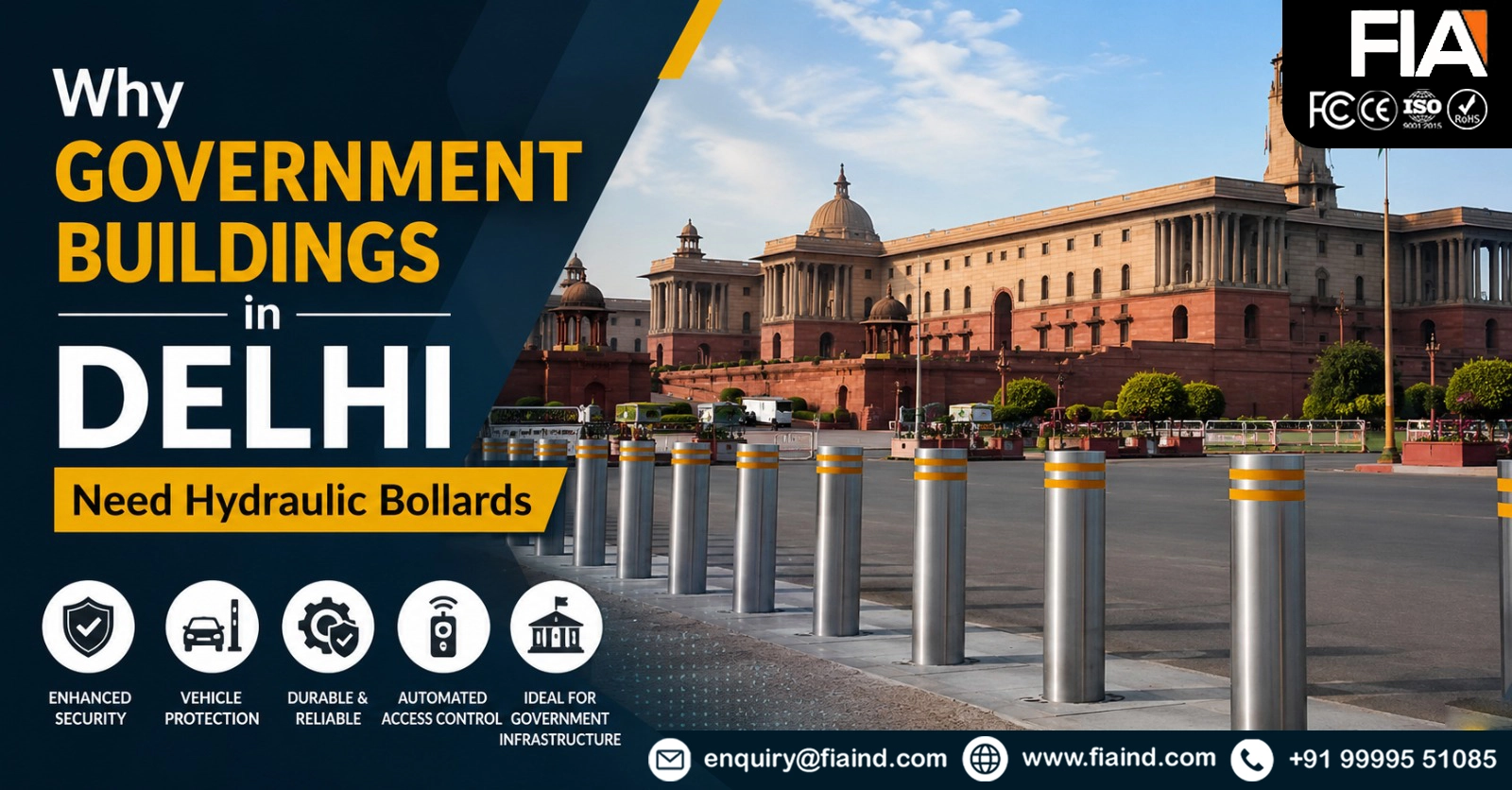
Delhi is home to some of India’s most sensitive government establishments — ministries, secretariats, embassies, courts, police headquarters, and public sector offices. These buildings deal with thousands of visitors, official vehicles, and sensitive information every single day. With rising concerns around vehicle-ramming attacks, unauthorised entry, and VIP security breaches, physical perimeter security has become just as important as digital security.
This is where hydraulic bollards play a critical role. Unlike static concrete blocks or manually operated barriers, a hydraulic bollard in Delhi government complexes offers controlled, fast, and reliable vehicle access management — stopping unauthorised or hostile vehicles while allowing smooth movement for authorised traffic.
In this blog, we’ll explain what hydraulic bollards are, why they matter for government infrastructure, how to choose the best hydraulic bollard for your facility, what affects hydraulic bollard price in India, and how an automatic hydraulic bollard system compares to older manual alternatives.
What Are Hydraulic Bollards?
Hydraulic bollards are retractable, ground-mounted security posts that rise from and retract into the road surface using a hydraulic power unit. When raised, they act as a physical barrier strong enough to stop a moving vehicle. When lowered, they allow vehicles to pass freely. The rise-and-fall action is typically controlled through:
- A control room operator
- Access cards or RFID systems
- Number plate recognition (ANPR) integration
- Remote or app-based controls
- Emergency manual override in case of power failure
Because they can be raised or lowered in a matter of seconds, hydraulic bollards give security personnel real-time control over who and what enters a premises — something static barriers simply cannot offer.
Why Delhi’s Government Buildings Are High-Risk Zones
Delhi, as the national capital, houses:
- Central Secretariat and ministry buildings
- Parliament and judicial complexes
- Foreign embassies and high commissions
- Police headquarters and paramilitary offices
- Public sector undertakings and regulatory bodies
These locations are high-value targets precisely because of their symbolic, administrative, and strategic importance. A single security lapse at a government building doesn’t just risk property damage — it risks lives, national reputation, and public trust. This is why security audits for government premises increasingly recommend anti-terrorist bollards and crash-rated vehicle barrier systems as a standard, not an optional add-on.
Key Reasons Government Buildings Need Hydraulic Bollards
1. Protection Against Vehicle-Ramming Threats
Vehicles carrying explosives or driven with hostile intent are one of the most difficult threats to stop using human security alone. Crash-rated hydraulic bollards are engineered and tested to absorb high-impact force, stopping vehicles before they can breach a perimeter, entrance lobby, or pedestrian zone.
2. Controlled, Real-Time Access Management
Government buildings deal with a constant flow of officials, employees, delivery vehicles, and visitors. An automatic hydraulic bollard system lets security teams grant or deny access instantly — without opening gates manually or relying solely on boom barriers, which are easier to breach.
3. Reduced Dependence on Manual Security Staff
Manual barriers and static blockades require constant human monitoring. Automated hydraulic systems reduce the margin for human error, especially during odd hours, VIP movement, or emergencies, while still allowing manual override when needed.
4. Deterrence Value
The visible presence of a robust bollard system signals a serious, well-secured facility. This alone discourages attempts at unauthorised entry or reconnaissance by bad actors scouting for weak points.
5. Compliance With Security Guidelines
Government and public infrastructure projects in India increasingly follow perimeter security norms that recommend crash-rated barriers for sensitive buildings. Installing certified hydraulic bollards helps facilities align with these evolving security expectations during audits and inspections.
6. Protection for Pedestrians and Public Spaces
Many government buildings have public-facing areas — reception zones, courtyards, and walkways — where footfall is high. Bollards prevent accidental or intentional vehicle intrusion into these pedestrian zones, protecting both staff and visitors.
Automatic Hydraulic Bollard vs. Manual Bollard: What’s the Difference?
| Feature | Manual Bollard | Automatic Hydraulic Bollard |
|---|---|---|
| Operation | Physically lifted/lowered by staff | Raised/lowered via hydraulic system |
| Response Time | Slow, labour-dependent | Seconds, remote-controlled |
| Access Control Integration | Limited | Compatible with RFID, ANPR, biometric systems |
| Suitability for High-Security Zones | Basic deterrence only | Crash-rated, high-security suitable |
| Operational Efficiency | Lower, especially at high-traffic points | High, ideal for continuous vehicle flow |
For high-footfall, high-risk locations like government secretariats, an automatic hydraulic bollard is almost always the more practical and secure choice.
How to Choose the Best Hydraulic Bollard for Government Use
Not all bollards offer the same level of protection. When evaluating the best hydraulic bollard for a government facility, consider these factors:
1. Crash Rating and Impact Resistance Look for bollards tested against recognised impact standards (such as PAS 68 or IWA 14 equivalents), which indicate the vehicle speed and weight the bollard can stop.
2. Rise Height and Diameter Higher rise (typically 600–1000 mm) and thicker steel bollards generally offer stronger resistance against larger vehicles.
3. Response Speed For high-security applications, faster rise/fall cycles (a few seconds) are preferable, especially where quick lockdown may be required.
4. Integration Capability The system should integrate with existing CCTV, access control, and control room software used at the facility.
5. Build Material and Weatherproofing Given Delhi’s extreme summers, monsoon flooding, and winter fog, bollards need corrosion-resistant coatings and sealed hydraulic units to function reliably year-round.
6. Manufacturer Track Record Choose vendors with proven government or infrastructure project experience, proper after-sales support, and locally available maintenance service — critical for uninterrupted security operations.
Hydraulic Bollard Price: What Affects the Cost?
Hydraulic bollard price in India varies widely based on several factors, so it’s important to evaluate cost against specification rather than price alone:
- Crash rating: Higher-rated, vehicle-arresting bollards cost more than light-duty deterrent bollards.
- Material and diameter: Thicker steel and higher-grade finishes increase cost.
- Automation level: Fully automatic systems with sensors and integrations cost more than semi-automatic units.
- Number of units and civil work: Foundation depth, drainage, and underground housing affect installation cost.
- Power backup requirements: UPS or battery backup for uninterrupted operation during power cuts adds to the overall system cost.
- Maintenance contracts: Annual maintenance contracts (AMC) for hydraulic units, seals, and control panels are usually priced separately.
For government tenders and institutional projects, it’s advisable to request a detailed cost breakdown covering the bollard unit, civil foundation work, control systems, and post-installation maintenance — rather than comparing only the unit price.
Installation Considerations for Government Premises in Delhi
Government buildings often have unique layout, traffic, and security constraints. A few practical considerations:
- Traffic flow assessment: Identify peak entry/exit points to avoid bottlenecks.
- Underground utilities check: Delhi’s older government complexes may have existing drainage, electrical, or water lines that need mapping before excavation.
- Redundant power supply: Ensure backup power so bollards remain operational during outages.
- Staff training: Security personnel need training on both automated operation and manual emergency override.
- Regular maintenance schedule: Hydraulic systems require periodic servicing of seals, fluid levels, and sensors to ensure long-term reliability.
Conclusion
As security threats evolve, static barricades and manual checkpoints are no longer sufficient for protecting Delhi’s government buildings. A well-specified hydraulic bollard system offers a practical balance between strong physical security and smooth day-to-day vehicle access — something every high-security government premises needs.
Whether you’re evaluating the best hydraulic bollard for a new facility, comparing hydraulic bollard price across vendors, or planning to upgrade an existing checkpoint to an automatic hydraulic bollard system, the priority should always be certified impact resistance, reliable automation, and a vendor capable of long-term maintenance support.
Investing in the right perimeter security infrastructure today isn’t just about compliance — it’s about safeguarding people, property, and public trust in the institutions that serve them.
Frequently Asked Questions
Q1. What is the main purpose of hydraulic bollards in government buildings? Hydraulic bollards control vehicle access and stop unauthorised or hostile vehicles from entering restricted government premises, protecting people and property.
Q2. How is an automatic hydraulic bollard different from a manual one? An automatic hydraulic bollard rises and retracts using a hydraulic power unit controlled remotely or through access systems, offering faster response and better integration than manually operated bollards.
Q3. What factors influence hydraulic bollard price in India? Crash rating, material thickness, automation level, number of units, civil foundation work, and maintenance contracts all influence the final price.
Q4. Are hydraulic bollards suitable for high-traffic government entrances? Yes. Automatic hydraulic bollards are designed for repeated, high-frequency operation, making them suitable for entrances with continuous vehicle movement.
Q5. How often do hydraulic bollards need maintenance? Most manufacturers recommend periodic servicing (typically every 3–6 months) to check hydraulic fluid, seals, sensors, and control panel functionality, especially in extreme weather conditions like Delhi’s.