
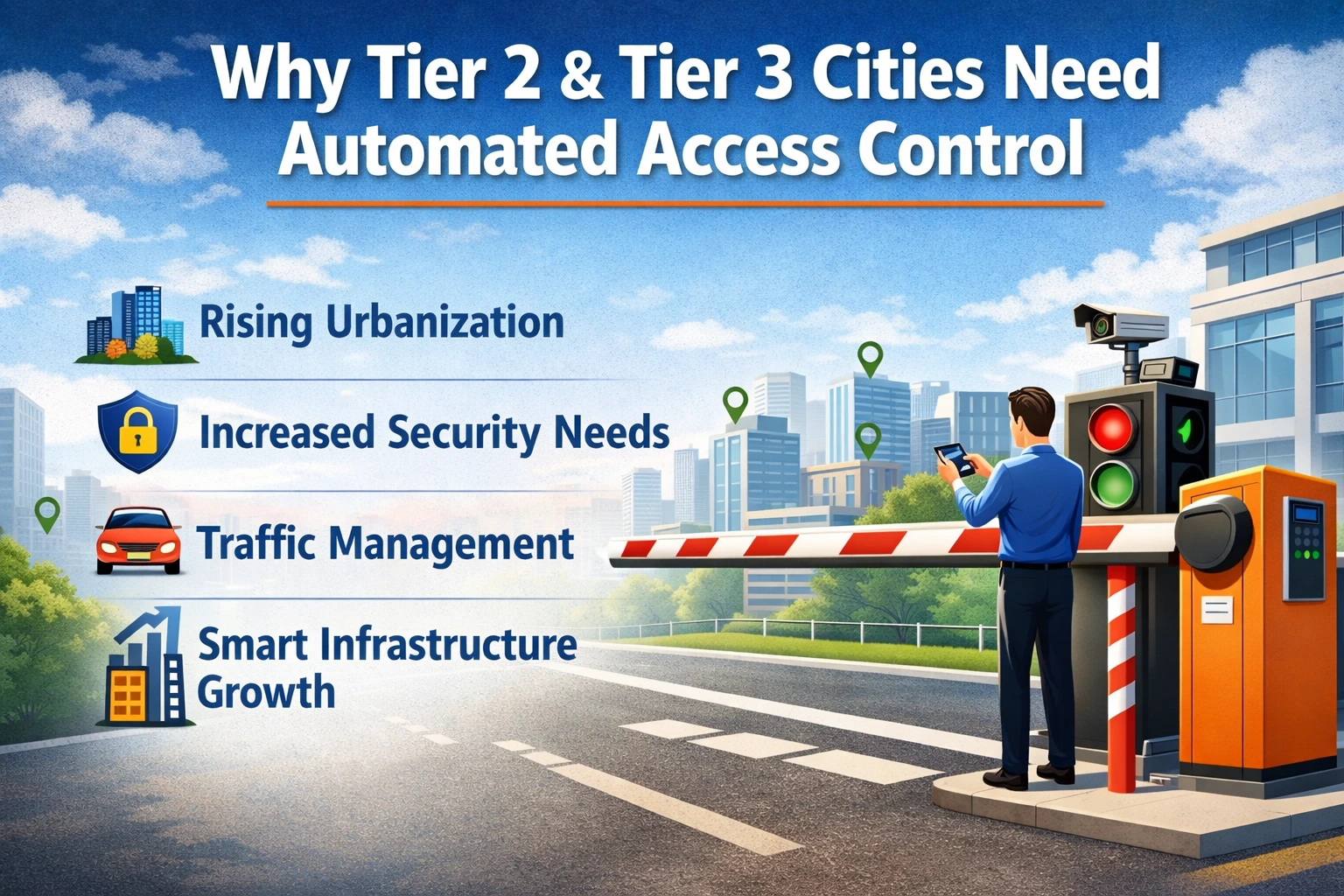
For years, automated access control was considered a luxury reserved for large metropolitan cities — sprawling corporate campuses in Mumbai, gated communities in Bengaluru, or high-security government buildings in Delhi. The assumption was simple: smaller cities do not have the infrastructure, the budget, or frankly the need for such systems.
That assumption is rapidly becoming outdated.
India’s Tier 2 and Tier 3 cities are undergoing a transformation unlike anything seen in previous decades. Cities like Indore, Coimbatore, Lucknow, Surat, Vadodara, Bhopal, Nashik, and Vijayawada are no longer quietly growing in the shadow of metros — they are attracting serious industrial investment, real estate development, educational institutions, and a rising middle class with evolving expectations around safety and convenience.
And with that growth comes an urgent, often overlooked need: smarter, more reliable access control.
The Ground Reality in Smaller Cities Today
Walk into most residential societies, commercial complexes, factories, or hospitals in a Tier 2 or Tier 3 city today, and you will still find the same security setup that has existed for decades — a guard cabin, a register, a manual barrier or chain, and a system that depends entirely on human presence and human judgment.
This model has three fundamental problems.
First, it is inconsistent. Security quality varies dramatically depending on which guard is on duty, what time of day it is, and how alert they happen to be. A tired guard at 2 AM is not the same as a vigilant one at 9 AM — yet the safety of an entire premises rests equally on both.
Second, it does not scale. As residential societies grow larger, as industrial parks add more units, as hospitals expand their campuses, a manual system becomes increasingly difficult and expensive to manage. More guards means more payroll, more supervision, and more coordination — with no guarantee of better outcomes.
Third, it leaves no verifiable record. When an incident occurs — a theft, an unauthorised entry, a dispute over vehicle access — manual systems rarely produce reliable evidence. Registers can be manipulated, and human memory is imperfect.
Why the Timing Is Right for Tier 2 & Tier 3 Cities
Several converging trends make 2025 and 2026 the right moment for smaller cities to make this shift.
Real estate is booming. Developers across Tier 2 and Tier 3 cities are launching gated communities, mixed-use townships, and commercial complexes at a pace not seen before. Buyers and tenants in these projects increasingly expect the kind of security infrastructure that was previously associated only with premium metro properties. Automatic boom barriers, flap barriers, and integrated visitor management systems are fast becoming standard features, not optional upgrades.
Industrial corridors are expanding. Government initiatives such as the Delhi-Mumbai Industrial Corridor and various state-level industrial parks are channelling significant investment into smaller cities. Factories, warehouses, and logistics hubs in these zones require disciplined vehicle access control — not just for security but for operational efficiency and compliance with safety standards.
Digital literacy is rising. The widespread adoption of smartphones and UPI payments across non-metro India has fundamentally changed what people expect from everyday systems. A resident in Nagpur or Rajkot who uses digital banking and online grocery delivery is perfectly comfortable with RFID-based entry systems or QR code visitor passes. The technology barrier that once existed is largely gone.
Labour costs are increasing. Even in smaller cities, the cost of hiring, training, and retaining security personnel has risen considerably. Automated systems, which carry a one-time installation cost and minimal ongoing maintenance, offer a financially attractive alternative over a three-to-five-year horizon.
What Automated Access Control Actually Looks Like on the Ground
It is worth being specific about what deploying automated access control in a Tier 2 or Tier 3 city context actually involves, because the image of a complex, expensive system often puts decision-makers off unnecessarily.
For a residential gated community, the typical setup involves an automatic boom barrier at the vehicle entry and exit points, integrated with a visitor management app that allows residents to pre-approve guests and delivery personnel. Residents enter using RFID tags mounted on their vehicles. Visitors receive a time-limited QR code that triggers the barrier automatically. The entire system requires minimal daily management and produces a full log of every vehicle movement.
For a factory or industrial unit, the focus shifts to controlling which vehicles enter the loading bay, tracking contractor and vendor visits, and ensuring that only authorised personnel access sensitive production areas. A combination of boom barriers for vehicles and tripod turnstiles or flap barriers for pedestrian entry creates a layered security perimeter that is both robust and auditable.
For a hospital, the challenge is managing high volumes of vehicles — patient drop-offs, ambulances, staff parking, and vendor deliveries — without creating chaos at the entrance. Automated barriers with designated lane management ensure that emergency vehicles always have priority access, while staff parking remains disciplined and visitor entry is controlled.
For commercial complexes and malls, the priority is smooth customer experience alongside security. Fast-opening barriers, integration with parking management software, and the ability to handle surge volumes during weekends or sales events make automated systems far more effective than any manual alternative.
The Concern About Cost — and Why It Is Often Overstated
The most common hesitation among facility managers and developers in smaller cities is cost. Automated access control sounds expensive, and it is true that the upfront investment is higher than simply hiring a guard.
But this comparison needs to be made over a realistic time horizon.
A single security guard in a Tier 2 city costs roughly ₹12,000 to ₹18,000 per month in salary alone, before factoring in overtime, leave cover, uniforms, and supervision. A typical entry point requires at least two guards for round-the-clock coverage — meaning an annual spend of ₹3 to ₹4.5 lakh per gate, every year, indefinitely.
A quality automatic boom barrier system, installed and commissioned, typically costs a fraction of that over a three-year period — and continues to operate reliably well beyond that. When you factor in the consistency, the data, the integration capabilities, and the reduced liability, the financial case is clear.
Local Installation and Support — No Longer a Barrier
One concern that was legitimate a few years ago was the lack of local technical support for automated systems outside of major cities. If something went wrong, getting a technician was a challenge.
This has changed significantly. Reputable access control suppliers now have dealer and service networks that cover Tier 2 and Tier 3 cities across India. Remote diagnostics, software updates, and preventive maintenance schedules mean that most issues are resolved quickly, often without a site visit at all.
The Bigger Picture
Automated access control is not just a security upgrade — it is an infrastructure investment that signals the maturity of a city’s built environment. When a housing society in Indore installs a properly integrated access system, or a logistics park in Coimbatore deploys automated vehicle barriers across its gates, it is participating in a broader shift toward smarter, more accountable urban infrastructure.
Tier 2 and Tier 3 cities are not lagging behind in this transition — in many ways, they have the advantage of building the right systems from the ground up, without the legacy constraints that slow down upgrades in older metro properties.
The question for developers, facility managers, and institutional decision-makers in these cities is no longer whether to automate access control. It is how soon, and which system fits best.
At FIA, we work with clients across India’s growing cities to identify and deploy the right access control solutions — from automatic boom barriers and flap barriers to tripod turnstiles and integrated visitor management systems. If you are planning a new project or looking to upgrade an existing facility, our team is here to help you make an informed decision.